
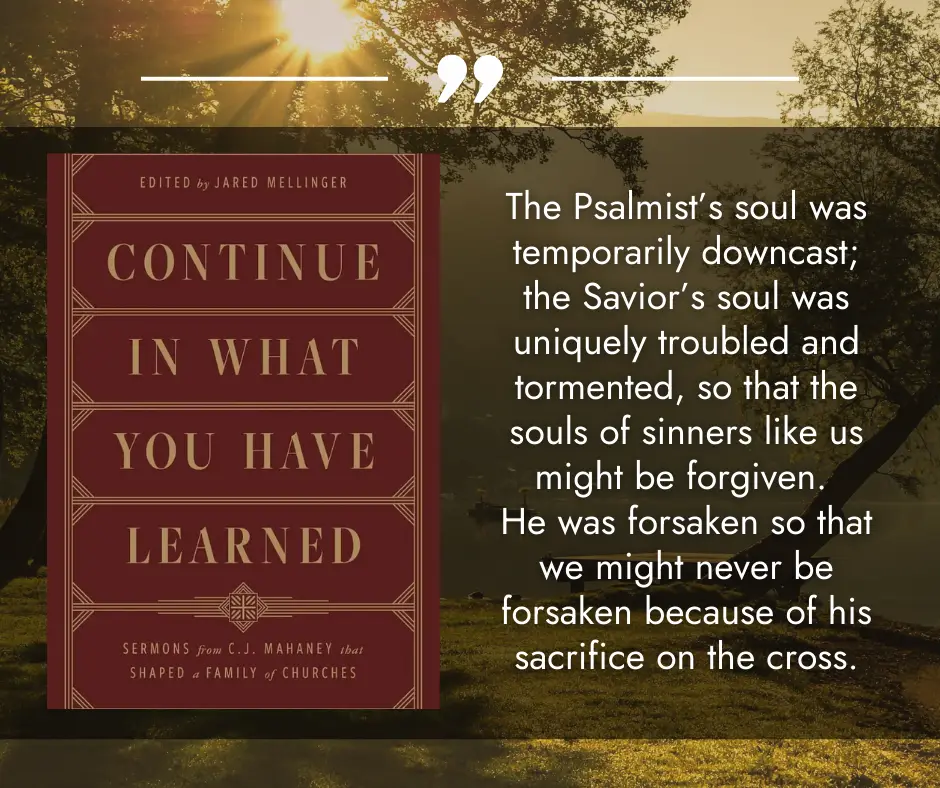
This collection of quotes from pastors and resources within our family of churches offers profound reflections on the substitutionary sacrifice of Jesus Christ on the cross and the heart of the Gospel.
Get free pdfs on the Resource Journals page and Books page of our website or purchase these resources at 10ofthose.com
“In the entirety of his life and death, Jesus Christ humbled himself to serve as our mediator in obedience to his Father’s saving purposes. As the second Adam, his sinless life of wholehearted obedience to God’s law obtained the gift of perfect righteousness and eternal life for all of God’s elect. In his substitutionary death on behalf of his people, Christ offered himself by the Spirit as a perfect sacrifice, which satisfied the demands of God’s law by paying the full penalty for their sins. On the cross, Christ bore our sins,took our punishment, propitiated God’s wrath against us, vindicated God’s righteousness, and purchased our redemption in order that we might be reconciled to God and live with him in blessed fellowship forever.”
“The Humiliation of Christ in His Saving Work” in We Believe: A Statement of Faith
“Here’s our hope: with the truth of God’s Word, with sound doctrine, with a biblical vision of a sovereign God and a mighty Savior, and a sin-atoning cross, and a glorious gospel that is the power of salvation for all who believe, and a risen Christ who will build his church, we have everything necessary for faithful ministry. Our mission will be sustained and protected and fueled and fruitful. We can, by God’s grace, experience faithful longevity as we ‘watch our doctrine.’”
Jeff Purswell, Watch Your Doctrine: A Call to Theological Fidelity
“One cannot read [Psalm 22] without remembering someone else whose soul was troubled—without remembering our Savior’s uniquely troubled soul as his death on the cross drew near. As the hour for which he came drew near, it would appear that he was alluding to this Psalm when he said, ‘Now is my soul troubled. And what shall I say? “Father save me from this hour”? But for this purpose, I have come to this hour’ ( John 12:27). And in the garden of Gethsemane, we overhear a similar cry: ‘My soul is very sorrowful, even to death’ (Matt. 26:38). The Savior’s soul was uniquely troubled and sorrowful. And as he encountered the wrath of God, as our substitute for our sin on the cross, he would cry out in indescribable agony, ‘My God, my God, why have you forsaken me?’ (Matt. 27:46)
The Psalmist felt forsaken by God; the Savior was forsaken by God. The Psalmist was troubled in soul as he felt the absence of God; the Savior was troubled in soul as he contemplated being crushed by the righteous wrath of God and truly abandoned by God. The Psalmist’s soul was downcast, but the Savior’s soul would be crushed. The Psalmist’s soul was temporarily downcast; the Savior’s soul was uniquely troubled and tormented, so that the souls of sinners like us might be forgiven. He was forsaken so that we might never be forsaken because of his sacrifice on the cross.”
C. J. Mahaney, “The Troubled Soul” in Continue in What You Have Learned: Sermons from C. J. Mahaney that Shaped a Family of Churches
This is amazing love—the good news of penal substitution. Because Christ died the death we deserve, fear and shame are gone, and our future is secure. ‘There is therefore now no condemnation for those who are in Christ Jesus’ (Rom. 8:1). We live every day in the good of knowing we have peace with God through the finished work of Christ on the cross.”
Shawn Woo, “In My Place: The Good News of Penal Substitution” in Christ our Treasure (Spring 2021)
“We are not just told to encourage each other, but to do so by speaking gospel words (1 Thess. 4:18) and by considering the encouragement that is in Christ (Phil. 2:1). There is some encouragement to be found in what God is doing in us and through us, but it is not as deep as the encouragement of what God has done for us. Our rejoicing comes ultimately not in knowing how we are being used by God, but in knowing that Christ shed his blood for us, that we are known and loved by God, and that our names are written in heaven (Luke 10:20).”
Jared Mellinger, Encouragement: How to See and Celebrate Evidences of Grace
Excerpt from C. J. Mahaney, “The Suffering Servant” in Continue in What You Have Learned: Sermons from C. J. Mahaney that Shaped a Family of Churches
From mere human observation as covered by the local media, Jesus of Nazareth would’ve been considered as justly judged by God, smitten by God, stricken by God, and afflicted by God for his sin. But those who have been given new eyes realize— oh yes!—He was indeed smitten by God. He was indeed stricken by God. He was indeed afflicted by God, but not for his sin, but for our sin!
We need to ponder this. We need to contemplate this deformed and disfigured body that appears before us. We want to look away, but Isaiah won’t let us look away. He’s addressing the tendency to say, “I didn’t do that. I’m not responsible for that.” And then he’s also taking us to the foot of the cross and revealing the essence of the suffering we observe there. Isaiah is taking us where no movie, however sincerely created, can take us. He is taking us to the foot of the cross, not simply to be overwhelmed by the physical suffering. He’s taking us to understand that the essence of what’s happening there is a substitutionary sacrifice for sins, satisfying the wrath of God and securing our justification.
You see, the excruciating pain that the Savior is experiencing— the deformed body that is appearing before those who are standing there, the disfigurement that is taking place so that it is said of him, that he is beyond human recognition—that isn’t merely suffering he’s experiencing at the hands of cruel, Roman authorities! What is happening before us? This disfigured one who groans before us, “My God, my God, why hast thou forsaken me?”—this individual is not merely experiencing physical suffering! This individual is drinking the cup of God’s wrath as the substitute for sinners like you and me.
Isaiah, and more importantly, God, fixes our attention on this despised and rejected one and says, “That’s my Son. That’s my servant. He hangs suspended, experiencing the fullness of divine righteous wrath as a substitute for those who esteemed him not, who despised and rejected him.” And wisely does John Calvin write that “When we behold the disfigurement of the son of God, when we find ourselves appalled by his marred appearance, we need to reckon afresh that it is upon ourselves we gaze, for he stood in our place.”
We gaze upon the disfigured one. We gaze upon the judgment we so richly deserved. He died in my place! He died in our place, for our sin! The innocent one endured the punishment that I, the guilty one, so richly deserve, that I might be spared that punishment of the wrath of God. That is the heart of the gospel. The heart of the gospel is the substitutionary sacrifice of Jesus Christ. God “made him who knew no sin to be sin so that we might become the righteousness of God” (2 Cor. 5:21).
Excerpt from Andy Farmer, “Trauma and the Treasure of Christ” in A Christ-Centered People (Summer 2021)
At the heart of Jesus is a heart to deal with trauma.
Think about it like this: Jesus came to experience trauma. Read the trauma story of the Suffering Servant in Isaiah 53. The cross checks all the boxes of a traumatic event. It was horrible. It was evil. It was premeditated. It was humiliating. It was isolating. It was crushing. You have in Jesus one who is intimately familiar with trauma.
But there are some things about the trauma of the cross that move beyond how Jesus can identify with our trauma to how he can transform it. First, Jesus welcomed his trauma. Read the passion narrative of Matthew 26-27. He embraced the trauma of the cross; he moved toward it, he offered himself up to it.
God became flesh to move relentlessly toward the deadly trauma of the cross. Why? Because that’s exactly what you needed him to do. That’s exactly what I needed him to do.
You see, the fundamental trauma that shapes us all is our corruption due to sin. Our lives apart from Christ are an endless reverberation of the self-traumatizing effects of the fall in Genesis 3. Genesis 3 is fundamentally the story of our rebellion against God. But Genesis 3 is also about the effects of that rebellion: the loss of innocence, the loss of identity, the loss of blessedness, the loss of love, all in one tragic moment that couldn’t be taken back. This is where all people do their coping, their escaping, their self-medicating, their self-justifying—the trauma of sin-guilt is the greatest problem underlying everything else we experience in life. Read Romans 1 and see the effects of the trauma of the fall. Jesus came to address that trauma once and for all.