
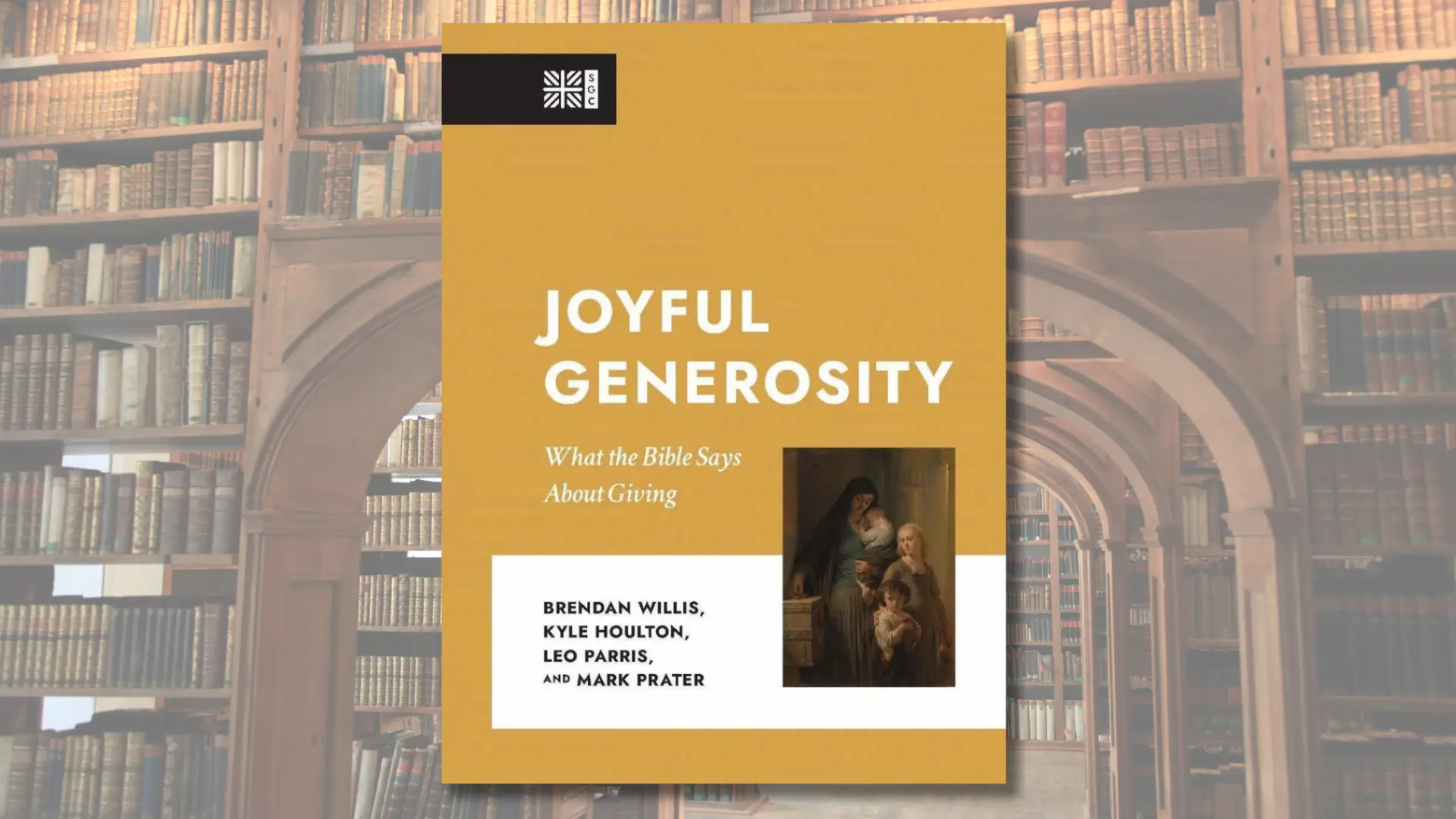
A Guide for the Anxious, Fearful, and Stingy
Drawn from “Joyful Generosity” by Willis, Houlton, Parris, Prater • Sovereign Grace Publishing, 2023
A TESTIMONY
From Ricky Alcantar, at Cross of Grace Church in El Paso, TX
I tend to be the kind of person for whom even discussions about personal finances creates an anxiety deep in the pit of my stomach. I can tend to view conversations about money and generosity as being maybe necessary, but often painful. ‘Joyful’ would not normally be the word I’d use to describe conversations around giving. However, this little book has been part of a recent journey from fear to faith, and from anxiety to joy.
Through this simply book, along with a recent Journey of Generosity retreat our church participated in, God is helping me see generosity differently. In fact, I’ve found that the more excited I am about God’s purposes, and the more confident that God will provide, the more joyful it has become to give. I’m moving from fear to faith and from stinginess to open-handed giving in multiple areas.
If you’re like me, your time considering this topic will be surprising, refreshing, and encouraging. Our brothers are worthy guides and manage to pack a ton of biblical theological in a few dozen pages. I’ve captured the highlights below, but encourage you to read the whole thing.
WHY GENEROSITY MATTERS
Christians are called to give — not out of obligation, but as a reflection of a God who is himself defined by generosity, supremely demonstrated in the gift of his Son.
THE BIG PICTURE
There is a compelling biblical thread of generosity that stretches from Genesis to Revelation — God gives, his people are made to reflect that giving, they fail, and Christ fulfills what they couldn’t. This means that generosity isn’t a personality trait some Christians happen to have — it’s baked into what it means to bear the image of God.
“God is full and he makes full.” — Kelly Kapic & Justin Borger, as quoted in the book
THE 9 CORE CLAIMS
1. God is generous by nature (Gen 1-2).
Creation is the opening act of generosity — spoken into existence out of nothing, with nothing needed in return. Unlike the gods of mythology who depend on sacrifice and worship, the God of Scripture gives from overflow, not need.
“When we give generously, we are living closest to the intention behind our very being— we are reflecting the greater generosity of God.”
2. God calls his people to generosity (Deut 12, 14, 15).
Israel was required to tithe (which the authors note could reach 23.3% when all OT giving requirements were combined), care for the poor through gleaning laws, and provide for temple workers. They largely failed — exploiting the poor (Amos 8) and withholding tithes (Malachi 3). Solomon is the cautionary tale: a man who asked for wisdom instead of wealth, then accumulated both and was destroyed by the latter.
“Israel was like an angry teen refusing to do household chores in a house they did not buy, eating bread they did not bake. Instead of trusting God for provision and experiencing the joy of generosity, they audaciously chose to hoard their own possessions.”
3. Jesus is the ultimate display of generosity (Phil 2:1-7).
The incarnation and the cross are framed as the definitive gift. The authors connect Paul’s financial language — redemption, inheritance, offerings — to the work of Christ deliberately. “For you know the grace of our Lord Jesus Christ, that though he was rich, yet for your sake he became poor, so that you by his poverty might become rich.” (2 Corinthians 8:9)
“It was on the cross that God most powerfully proved his generosity.”
4. Jesus warns of the danger of the love of money often (Matt 16:24-26).
Of all the topics Jesus addresses in the Gospels, money tops the list. He warns that wealth can block entry into God’s kingdom, choke out his Word, and mask spiritual bankruptcy. The authors are direct: we are no better than Judas, who walked with Jesus for three years and still fell to the love of money.
“The call to follow Jesus means nothing short of dying to our own selfish desires for our life. There is no person consumed with becoming rich and also consumed with following Jesus.”
5. The early church gave sacrificially and joyfully (Acts 2:45-47).
Acts 2 and 4 describe a community where no one claimed their possessions as their own and no one had unmet needs. Barnabas selling his field is held up as the model; Ananias and Sapphira’s death for dishonest giving is described as sobering but ultimately encouraging — evidence that the Spirit will expose counterfeit generosity.
“Christ had given [the early church] his happy, benevolent heart and the world looked on in wonder. God was in them and God was using them to pour out his unending generosity.”
6. Christians are commanded to be generous to the poor and their pastors (James 2:14-17, 1 Tim 5:17).
The apostles’ singular ask of Paul was to remember the poor (Galatians 2:10). Paul commands churches to financially support their elders — and while this passage makes most pastors uncomfortable to preach, it is a clear matter of obedience in Scripture (1 Tim 5:17).
“Though this generosity should be displayed in care and concern for all those in need, Christians are called to especially care for those in our local churches.”
7. Giving should be done sacrificially and cheerfully — not because of coercion (2 Cor 8-9).
Paul deliberately refuses to use his apostolic authority to demand the Corinthian offering. He wants willing hearts, not extracted compliance.“Each one must give as he has decided in his heart, not reluctantly or under compulsion, for God loves a cheerful giver.” (2 Corinthians 9:7)
“The heart that has been saved by the work of Jesus Christ will be so amazed at the riches they have received that they will cheerfully give beyond their means with the full expectation that God will abundantly provide.”
8. Christians are blessed in their generosity (2 Cor 9:6-11).
Though it may surprise us, the Bible says that those giving will be blessed. Those blessings are rooted in spiritual dimensions, but God is eager to bless his people in many ways. That blessing will come in this life but we’re especially pointed to the life to come. One of the authors, a professional fundraiser, notes that the most generous donors he works with are consistently among the most joyful people he knows — and that generosity tends to compound: giving begets more giving.
“You cannot out give the giver of life!”
9. Giving extends beyond the local church (Acts 11:27-30).
Paul’s decade-long relief effort for Jerusalem Christians, the Philippians’ sustained financial partnership with Paul’s mission, and John’s commendation of missionary support in 3 John 5–8 all point to giving that travels beyond the local congregation. The Scriptures call this “partnership in the gospel” — not charity, but co-laboring.
THE TITHE?
The New Testament doesn’t command tithing explicitly, but for the Christian it should often function as a a floor, not a ceiling. God calls us to generosity and that’s a helpful starting place for many. In addition, on a practical level, without at least a tithe from its members, it’s hard to imagine a local church adequately caring for its poor, paying its pastors, or funding mission.
“Conformity to Christ is our calling as Christians. Thus, the biblical standard for giving is ultimately a person, not just a percentage.” (Kelly Kapic & Justin Borger, quoted in the book)
THE HISTORICAL EXAMPLE
The book closes with the story of Humphrey Monmouth, the small business owner who funded William Tyndale’s English New Testament translation — the project that opened the Reformation to the English-speaking world. Monmouth spent a year in prison for it. History forgot him. The authors’ point: most gospel givers are invisible to history but not to God.
“God rarely moves salvation history forward apart from generous benefactors of the Church. But history rarely remembers these gracious supporters.”
THE BOTTOM LINE
Generosity isn’t a spiritual add-on — it’s part of God’s very design for us as we reflect him. The most generous Christians are also the most joyful, as they most closely imitate God’s heart.
“Reflect the generosity of God the Father and become more like His Son, Jesus Christ. It’s not about the amount. It’s about the heart—like the widow’s heart. As you give, believe that God will write a chapter of salvation history (even if only in the life of one of your unbelieving neighbors) through your giving. Give to the one great eternal cause of the advance of the gospel.”
—The previous points were drawn from “Joyful Generosity” from Sovereign Grace Publishing. Get the full book here.