

In this episode, Ricky and Ben contrasts “Give Thanks” gratitude, which stays at ground level and fades with the next disappointment, with biblical thanksgiving. Biblical thanksgiving looks up to the changeless Giver in James 1:17–18, and Romans 1 shows that refusing to thank him is a matter of life and death, so don’t settle for anything less than the real thing.
The Clash Vs. Podcast is available on YouTube and wherever you get your podcasts.
The thanksgiving the world around us celebrates isn’t the real thing. It has been replaced. We’re buying a knockoff.
Years ago, I took a group of American kids to the mercado across the border in Juárez for the first time. We were amazed: real soccer jerseys, jewelry, and fancy watches, all for cheap. As we left, one of the kids proudly announced that he’d gotten a real Invicta watch for $40. A friend from Mexico laughed and said he had probably overpaid by $20. The watch was a knockoff.
That’s what has happened to thanksgiving. I don’t just mean the American holiday. I mean the whole season of “gratitude” and “thankfulness” that sets in every November. There are “Give Thanks” shirts, gratitude journals, and THANKFUL pieces of modern farmhouse furniture. Yet I’m convinced that much of what falls under the umbrella of “thanksgiving” is a knockoff.
I’ve spent parts of the last year writing a book on gratitude, and it has been both convicting and encouraging. Convicting, because I’ve realized how many unbiblical attitudes about gratitude I’ve absorbed from the culture around me. Encouraging, because thankfulness is more achievable, more desirable, and more transformative than I imagined.
Spot the Difference
Here is a quick overview of the differences between knockoff thanksgiving and biblical thanksgiving.
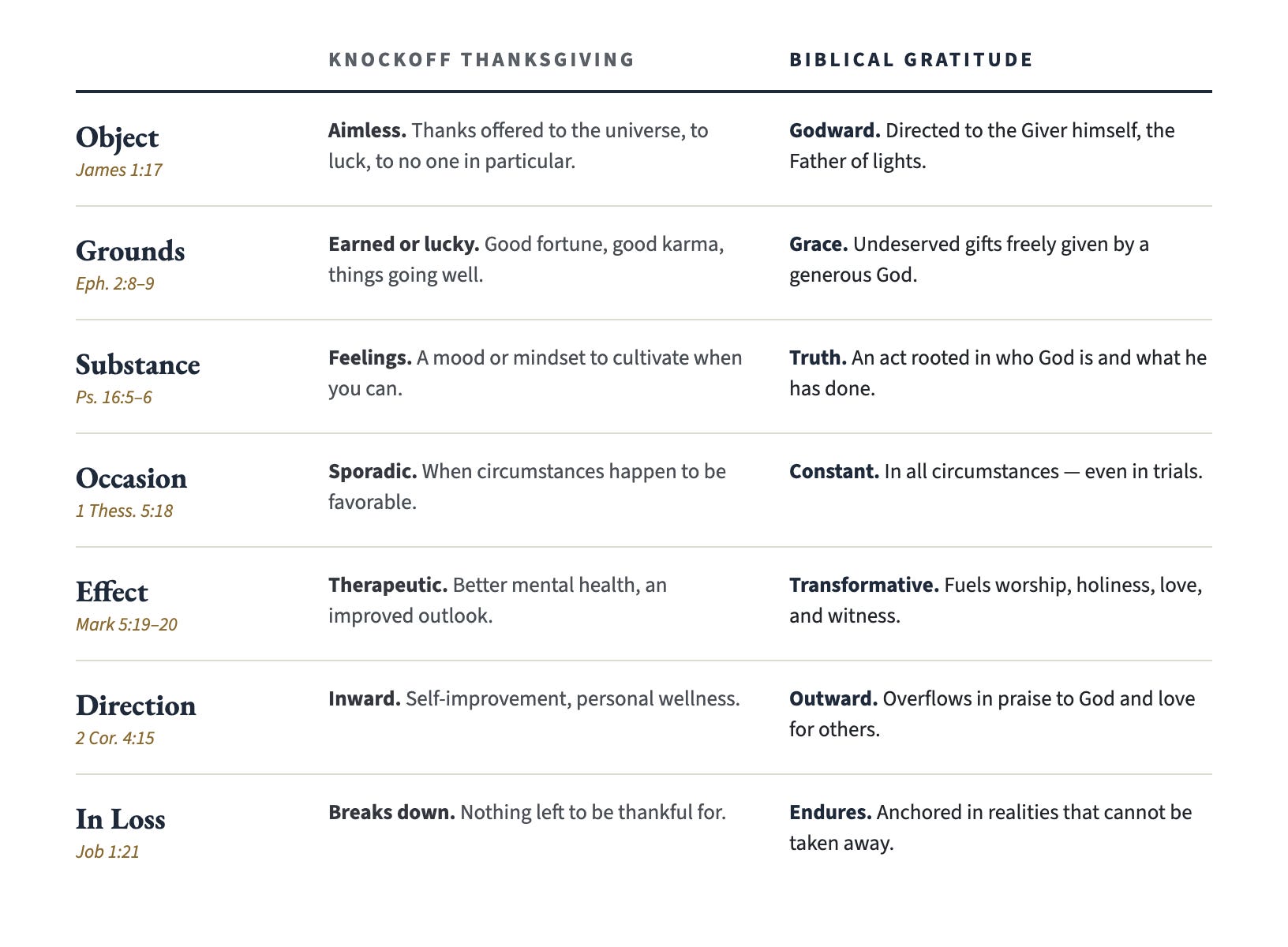
[You can download a PDF of the chart here]
There’s a lot there, but I hope you see the difference.
Imagine a person excited for the season of thanks. They happily pull out the fall decor and hang a big “Give Thanks” banner for Friendsgiving. At dinner, each person names one thing they’re grateful for. Everyone feels lucky and happy. Feeling much better afterward, they resolve to keep a gratitude journal for the rest of the year.
You can do all of this without biblical thanksgiving at all.
Here’s the tell: it doesn’t last. Gratitude as a feeling rises and falls. It becomes a vibe and an occasional visitor, usually gone by the next big disappointment or hurt.
The Bible offers something far better.
Remember the One Thing That Changes Everything
In my study, one thread runs through every contrast between knockoff and biblical thanksgiving: a Godward dimension. Knockoff thanksgiving is entirely horizontal. It looks at life at ground level and never looks up. Biblical thanksgiving adds the vertical.
Every good gift and every perfect gift is from above, coming down from the Father of lights with whom there is no variation or shadow due to change. Of his own will he brought us forth by the word of truth, that we should be a kind of firstfruits of his creatures. (James 1:17–18, ESV)
The “above” makes the difference. We lift our eyes from the gifts to the source. True thanksgiving is vertical.
The “Father” makes the difference. We see the one who made us and loves us. True thanksgiving is relational.
The “no variation or shadow due to change” makes the difference. In a fallen and broken world, we look around and see gifts, then look up and see a changeless Giver. True thanksgiving is rooted in the steady and sure presence of God.
Remember What’s at Stake
We might shrug and think, “Okay, maybe I need to be a little more intentional about biblical thanksgiving.” But this is not a peripheral issue. In Romans, thanksgiving is a matter of life and death.
For what can be known about God is plain to them, because God has shown it to them. For his invisible attributes, namely, his eternal power and divine nature, have been clearly perceived, ever since the creation of the world, in the things that have been made. So they are without excuse. For although they knew God, they did not honor him as God or give thanks to him, but they became futile in their thinking, and their foolish hearts were darkened. (Romans 1:19–21, ESV)
Paul offers a diagnosis of what ruined the world, and unthankfulness is part of it. People see God above, as Father, and turn away. Part of that turning is refusing to give thanks, refusing to acknowledge him as the Giver. And when you turn from the Giver, your mind and heart become bent and warped. Rituals of thanksgiving become exercises in futility, as we give thanks to nothing and are grateful to no one.
We see this in the garden. Adam and Eve didn’t look with thankfulness on all that God had given. They looked with unthankfulness on the one thing he had forbidden.
So it is with us. Whenever we look at life and refuse to thank God as the Giver, refusing to trace our gifts back to him, our hearts bend in ugly directions. But when we see God, acknowledge him, and see the Giver in his gifts, our hearts are set back into alignment.
The War on Thanksgiving
Years ago, there was talk of a “War on Christmas.” Some of it was understandable, and some of it was hilariously overblown. I want to call for a war on thanksgiving. Not a war against it, but a war to reclaim it.
Perhaps we’d do well to recall Edward Winslow’s words about the 1621 thanksgiving in Massachusetts, written after the colonists celebrated with a feast: “And although it be not always so plentiful, as it was at this time with us, yet by the goodness of God, we are so far from want, that we often wish you partakers of our plenty.”
Amen.
Don’t Be the Sucker
Remember my friend who bought the knockoff watch? Don’t feel too bad for him. After learning the watch was a forgery, he said he was pretty sure he could sell it at school for $100. He probably did. There’s always another sucker buying a fake.
Just don’t be the sucker. Don’t settle for anything less than the real thing.
Real thanksgiving is rare these days, but when you find it, it is transformative, objective, constant, and powerful. Don’t let it go.
ABOUT
Ricky Alcantar serves as Pastor at Cross of Grace Church in El Paso, Texas and the Editorial Director for Digital with Sovereign Grace Churches.
Ben Kreps serves as pastor at Living Hope Church in Middletown, Pennsylvania and also hosts the Mark Prater podcast.