
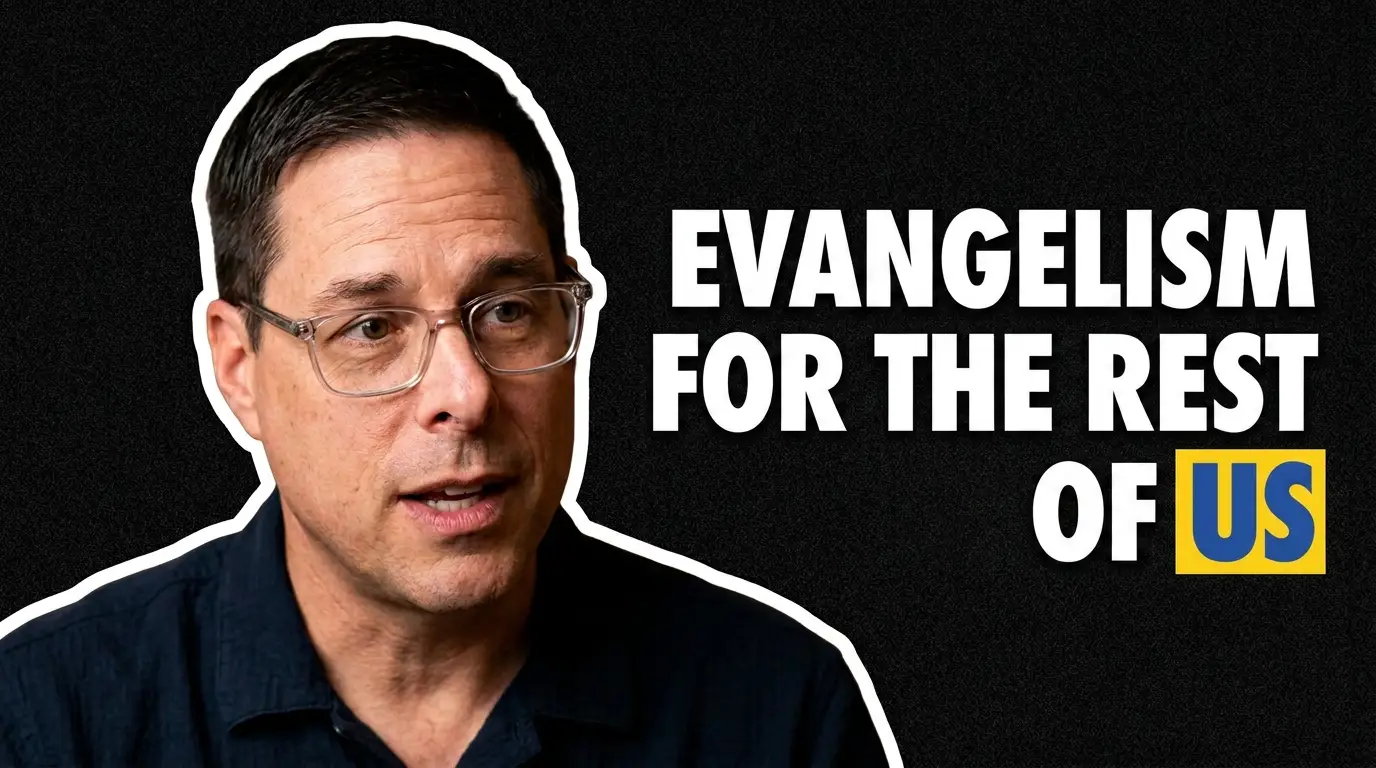
Editorial note: We’re excited to launch a new video and audio podcast from Jim Donohue called “The Ordinary Evangelist.” This intro episode lays out why evangelism seems so hard, and what we can do about it. We’re still experimenting with this format and distribution, so send any feedback to us at ricky.alcantar [at] sovereigngrace.com.
Why Evangelism Seems so Hard Sometimes
Host: Jim Donohue, Pastor & Evangelist, Covenant Fellowship Church (Glen Mills, PA); Director of Evangelism, Sovereign Grace Churches
Introduction
Welcome to the Ordinary Evangelist Podcast. My name is Jim Donohue.
I grew up in South Jersey. I was born into an Irish Catholic family, but very sadly my parents died — they were actually killed when I was four years old. My brother and I (I have a twin brother) were adopted by my aunt and uncle. We were raised Episcopalian, and I never heard or understood the gospel growing up.
But God saved me my freshman year in college. I’ve been a pastor and evangelist at Covenant Fellowship Church in Glen Mills, PA — just outside of Philly — for over thirty years. I’m also the Director of Evangelism for Sovereign Grace.
During these last three decades, I’ve been trying to help Christians find ways to share the gospel with those around them. But it hasn’t been easy. It’s not easy for me, and it’s not easy for most Christians. We live with the greatest news that exists on earth, but somehow sharing this life-changing news is probably the hardest part of being a Christian. It’s probably the hardest area in which to obey God.
So why is evangelism so hard? There are several reasons.
Obstacle 1: We’re Scared
Evangelism is the one area of the Christian life that can get you persecuted.
Now, the persecution we face in the West is, at worst, soft persecution. In other parts of the world, Christians often face beatings and even death for sharing their faith. But for most of us, at worst, evangelism can bring ridicule or rejection — and even that’s enough to scare us off and keep us from sharing the gospel. We care too much about what others think.
The Bible calls this the fear of man, and it tempts us to keep the glorious gospel to ourselves. Rico Tice, in his book Honest Evangelism, talks about the “pain line” in evangelism: if we’re going to be faithful, we have to risk crossing that pain line.
Part of that pain line is the message we bring — the message of the gospel, that we are all sinners who deserve hell and can only be saved through the death of Christ. That’s not a popular message. In fact, everything we believe is basically offensive. We’ve lost whatever popularity we once had, and we’re increasingly seen as hateful, unethical, and oppressive. The opposition is growing, which should not surprise us. Jesus prepared us for it, and he faced tremendous opposition from the time he was born and throughout his ministry.
Obstacle 2: We Feel Guilty
We know we should do something. We know we can’t just ignore the lost. But we’re scared, we don’t know what to say, we don’t know how to answer questions — and we feel like failures.
The flesh, the sinful nature that lives inside of us, loves when we feel guilty. It loves to condemn us and to keep us from the change that is available to us in the gospel. When we feel guilty or condemned, it’s almost impossible to change.
Part of the reason for this is that we often confuse condemnation and conviction:
Condemnation is a general sense of our failure — a black cloud that hovers over us.
Conviction is specific and sharp. It comes from the Holy Spirit, and it’s designed to help us change.
The Bible says that if we confess our sins, he is faithful and just to forgive us and cleanse us from all unrighteousness.
Obstacle 3: We Don’t Feel Gifted
One of the reasons we struggle is that we make a lot of wrong assumptions. We assume that to be successful we have to answer hard questions on the spot, memorize a lot of Scripture, and lead someone through the sinner’s prayer.
Another wrong assumption — maybe the main one — is that we think we have to be gifted to do evangelism. We think we need a certain personality or a certain amount of boldness, and that it’s best to leave evangelism to the ultra-aggressive, somewhat obnoxious, Marine Corps types.
People often tell me they don’t have the gift of evangelism, assuming that some are called to reach out and others are called to do things like hospitality. I don’t know why people tell me this all the time, but they say, “I don’t have the gift of evangelism. I have the gift of hospitality. So I can’t share the gospel, but I can make muffins.”
But there’s no such thing as the gift of evangelism. There is the gift of an evangelist — we see this in Ephesians 4 — someone called not only to preach the gospel but to equip others to do it. Evangelism itself isn’t a gift; it’s something we’re all called to.
Obstacle 4: Indifference
We don’t think about it very much. We don’t think about the lost very much. We don’t think about eternity very much. We don’t think about heaven and hell. We’re more focused on the here and now — and honestly, we’re more focused on ourselves and the things that bring us pleasure. We take up most of our own thoughts and time, and that leaves very little for the lost.
But the problem isn’t just that we aren’t focused on others. It’s that we’re not focused on God enough.
Seeing God Rightly
Michael Reeves, in God Shines Forth, says that unless we honestly find God to be beautiful and enjoyable, we’ll have nothing worth saying to the people around us. Until we see him rightly, we’ll have no genuine desire to fill the world with the knowledge of God.
We need to see God accurately. And when we do, we see a God who — as Reeves continues — is so full of life and goodness that he loves to be known. Not as a campaign to impose himself on us or on the world, but to give himself and share his own life with the world. God gives himself to sinners like us so that we might worship him and enjoy him forever.
Evangelism is, and always has been, essential to God — and it should be essential to us. It should be the natural overflow of the enjoyment we have in God. But we Christians can easily lose sight of our mission. We can lose sight of eternity.
There Is Hope
I have good news: there is tremendous hope for us in overcoming these challenges. Evangelism is actually much easier than we think — and I’ll talk about that in our next episode.
Let me say this: this podcast is here to help. Maybe you feel scared, or guilty, or indifferent. Maybe you feel you don’t have the gifts to do this, or you don’t have the time. This is where we can help. We are here to come alongside you. We have developed — and continue to develop — tools to help you with all of this, regardless of the size of the church you’re part of.
We’re not going to blow you away with things to do. We’re going to help you both theologically and practically. And by God’s grace, we will see the lost saved and added to the church.
I want to talk about the things that are on your mind, so feel free to send me your questions at [jdonohue@covfel.org]. Let’s figure out together how we can join God in the unstoppable spread of the gospel.