
Introduction
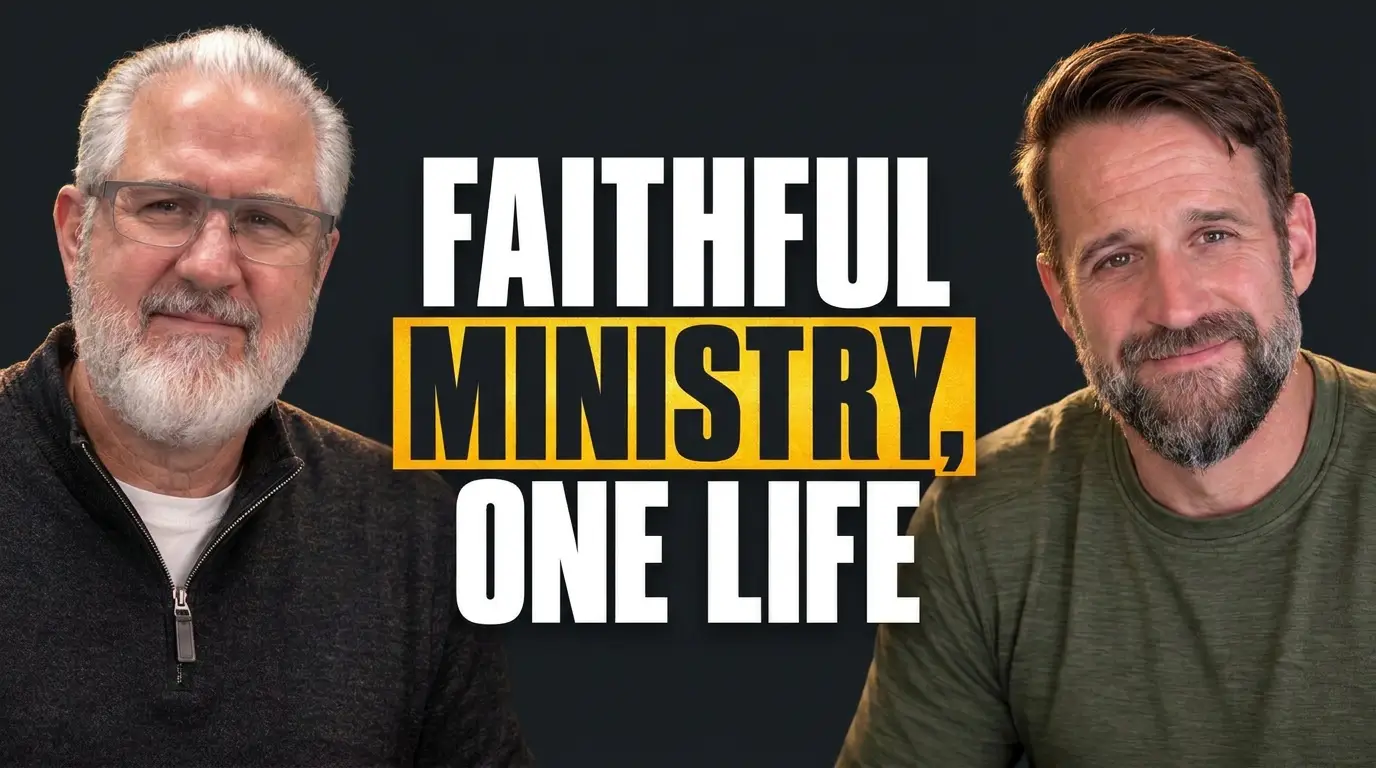
Walt Alexander: Welcome back to the Ordinary Pastor Podcast. I’m Walt Alexander, a pastor in our family of churches, Sovereign Grace. As you know if you listened to our last podcast with Steve Teter, we’re in a new season with a new host: me. For better or worse, you’ll have to decide.
There’s also a bit of a new direction. Numerous Sovereign Grace pastors are my heroes, faithful, ordinary pastors. Throughout church history, the church has marched forward through the faithfulness of very ordinary men who’ve taken up the cause of Christ where God has called them. In this new direction, we’re trying to take you behind the pulpit, into the lives and ministries of the men who make up our family of churches.
Today I’m excited to have on a friend I’m just getting to know, a faithful, ordinary pastor in our family of churches: Tim Kerr. Welcome, Tim.
Tim Kerr: I can hear my mother clapping.
Walt Alexander: That’s right. Your mom and my mom, that makes two.
Tim is from our neighbor to the north, Canada, north of Toronto. He planted Sovereign Grace Church of Bradford in 2005 and still serves there, dividing his time between mentoring pastors and emerging leaders. He and his wife, Joanne, have four adult children and a growing number of grandchildren. Tim, where did you grow up?
Growing Up in India
Tim Kerr: I was born in Canada, and my parents went as missionaries to India, so I spent my early years there. My dad later came back and pastored the church that sent them out. He was an assistant pastor there and was instrumental in starting the mission he went out with. He was really their first missionary, and it’s a church-planting mission all around the world today.
We moved around a lot. I lived in seventeen different homes while we were in India. My dad started as the administrator of a leprosy colony, so I grew up in a leprosy colony. Truth really is stranger than fiction. He wore a lot of hats. Eventually we moved to Calcutta, where he taught at Carey Bible Institute, and then he planted and pastored a church in Bangalore. So we were all over India.
Coming to Faith
Walt Alexander: You were raised in a home where your parents confessed Christ. How and when did you come to saving faith?
Tim Kerr: My grandfather was a pastor and church planter as well, and I heard the gospel from the time I was very young. I was your typical rebellious pastor’s son. I knew the gospel, but I didn’t submit to it until I was eighteen, through a rather dramatic turn of events. I won’t tell the whole story, but it was very significant. God changed me on a dime.
I remember sitting in a service wrestling with God, thinking there was too much to give up if I followed Christ. Suddenly everything changed, and I just wanted to follow him. So metanoia makes a lot of sense to me. God just changed my mind. That was a little while back. I’m sixty-three, going on sixty-four.
Walt Alexander: Were you living in India then?
Tim Kerr: No. I went over when I was a year old and came back when I was twelve. I lived in Canada from twelve until I was twenty-five, when we moved to Japan, where we stayed twelve years. So I came to Christ about seven years before going to Japan.
Family
Walt Alexander: Tell me about your family.
Tim Kerr: I have four children, all grown. My oldest is thirty-eight, and my youngest is thirty-two. We have ten grandchildren. The oldest and the youngest are boys, and the rest are granddaughters. I’ve never had so much fun in all my life.
Walt Alexander: That’s awesome. Are they local?
Tim Kerr: Many of them are. We have a special arrangement: my oldest son lives three doors down from us with five of my grandkids. My wife’s parents lived with us for eight or nine years. Her father died this year, but for a long stretch we had four generations under one roof.
My youngest, who is thirty-two, has special needs and will live with us all his life. Another son lives in downtown Toronto with his wife and daughter. And my daughter lives in Switzerland, married to a Swiss man. They have four daughters born in four and a half years.
Walt Alexander: Why not? Get it done while you can.
Tim Kerr: That’s right. I’m loving this season.
Called to Ministry, Despite Not Being the “Type”
Walt Alexander: How did you discern your calling to pastoral ministry?
Tim Kerr: On my dad’s side of the family there are Christian leaders going back several generations, so there was an expectation that I’d be a pastor too, and I resisted with all my might. At first I wasn’t even a believer. Even after I came to Christ, I didn’t want it.
But at eighteen I had an insatiable desire to share Christ. I did evangelistic outreach with all my friends, first at their houses and then on subways and buses. Nobody who knows me today would call me an evangelist, but back then that’s all anyone thought I was. People started asking, “Tim, have you ever considered ministry?” Different people, unrelated to each other, said it. I’d say, “Not really. I’m not the type.”
Eventually enough people asked that I talked to my dad. I told him I didn’t think I was the type for ministry, whatever that means. He said, “Start praying about it, and I’ll pray with you.” Through that time, the Lord gradually changed my mind and made me willing.
Walt Alexander: What did you mean by “not the type”?
Tim Kerr: I had in mind a certain kind of pastor, with a certain kind of intelligence and presence. My dad is very good up front with people, and so was my grandfather. I knew I wasn’t that person. I didn’t like public speaking or being in front of people.
But I submitted to it. When I got to seminary, one of the guys in my first-year class was a farmer who had sold his farm and was living off the proceeds for four years. Another was an insurance salesman at a large company. A third had been the equivalent of a Green Beret in the Lebanese army. I thought, okay, there’s no such thing as a type.
Walt Alexander: That’s so helpful, because we often think of ministry only in the terms presented to us. My friend Bill Kittrell in Knoxville was the first pastor I ever wanted to be like, which really means he was the first pastor I ever imagined I could be like. Ministry became an option for me because I saw someone do it in a way that was inspiring. So where did you go to seminary?
Seminary
Tim Kerr: A seminary that no longer exists: Central Baptist Seminary. It had about 120 students, and what was unique was that it was taught entirely by pastors and planters who were also scholars. At the time, eighty-five percent of graduates went into full-time ministry. It has since merged with another seminary and is now taught by many scholars who haven’t been pastors. I heard recently that about fifteen percent of graduates go into ministry.
It’s like you said, Walt. If you’re taught by academics, you want to go into academia. If you’re taught by pastors and planters, you get excited about planting and pastoring. A new professor joined during my first year, Michael Haykin. Don Carson went to that seminary too. It was a small, out-of-the-way place, and I’m very grateful for the years I had there.
Walt Alexander: Anyone who’s read Dr. Carson’s book about his father will wonder how that intersected. Would your family have known his father, Tom?
Tim Kerr: My grandfather and my dad knew Dr. Carson well. When I was in Japan, I wrote him letters asking about hermeneutics and all kinds of things. That’s how old I am. Every time, he wrote back a detailed, two-page letter answering my questions. Those are precious mementos.
Walt Alexander: Print those up. We’ll read them too.
Finding Sovereign Grace
Walt Alexander: So that’s a Baptist seminary. How did you get connected with Sovereign Grace?
Tim Kerr: It’s such a wonderful story. While I was planting in Japan, I was steeped in the Puritans. I loved John Owen and Richard Baxter. My dad and grandfather were Reformed, so I grew up thinking in a Reformed way. In Japan I encountered the charismatic movement, and I saw the worst and the best of it. There was a little move of the Spirit there, and something stirred in me that I hadn’t encountered in my earlier life.
I remember sitting at a desk with my wife, saying, “I’m sure there are people in the world who believe in the gifts of the Spirit but also believe in the gospel at the center, Reformed doctrine, sound doctrine, and exegetical preaching. But we’ll never find them, because those two things just don’t come in the same box.”
Fast-forward several years. I’m in Canada, involved in a mentoring ministry, and I’m between calls in a city close to Toronto. I walk into a small, mystical Catholic bookstore and think, there’s nothing here for me. Just before I leave, I see a little shelf labeled “Books on the Cross,” with maybe fifteen books on it. A little orange book caught my attention. It was by a man named C.J. Mahaney, whom I’d never heard of. I flipped through the table of contents and thought, this actually looks good. I read a couple of pages and liked them. I’m always looking for good books on the cross that are theological but short, for men. So I bought it, read it, and liked it so much that I bought a box of fifty to give to the guys. I never researched who he was.
Several months later, my wife came into my office, found the book, and asked, “Who is this?” I said it was a really good book I was using with the guys. She looked at it, and she’s an introvert who never does this kind of thing, and said, “Who are these Sovereign Grace people? Why don’t we find out?” I had never even thought of that. She sat down at my computer, which I don’t think she’s done since, and that was twenty-two years ago. We started clicking links and reading.
One of the big things for us in Japan was complementarianism. We felt it was fading in our group, and we wondered if we were the only ones on the planet who cared about it. Now we were reading about prophecy, doctrine, church planting, Reformed theology, and an emphasis on humility, kindness, and generosity. We said, what on earth?
I found out they had conferences, so I asked if they let anyone from outside their group attend. Mark Altrogge got back to me and said, “Come on down.” The conference was in Baltimore, only a few weeks after we first made contact, so we cleared our schedule and drove down. I had some life-changing experiences there, both in the teaching and in things that happened to me. On the way back, we knew something was going to change for the rest of our lives.
It was as if everybody had the same nose as us. We had finally found our long-lost family, and we hadn’t even known we had another family. It was an unusual moment for us. We had a ten-hour drive back to Canada, and we were just stunned. That’s how it began: with C.J.’s book, randomly found in a small bookstore I had never been to.
Walt Alexander: That is so encouraging. I have a thousand questions, but I’ll restrain myself. You’ve been in pastoral ministry how long?
Tim Kerr: About forty-two or forty-three years.
What Is Pastoral Ministry?
Walt Alexander: If someone asked you, “What is pastoral ministry?” how would you define it in a few sentences?
Tim Kerr: I think there’s a public dimension and a private dimension. Several passages have shaped my view, but three or four stand out.
A huge one is Acts 6:4: “We will devote ourselves to prayer and the ministry of the word.” How many times over the years have I asked my wife, “What am I supposed to be doing?” and she says, “Prayer and the ministry of the word.” And I say, “Yeah, that’s what I thought.”
Another is Titus 1:9, about the conviction of sound doctrine and being able to defend it. Another is 1 Timothy 4:16, about watching ourselves and our teaching so that we save both ourselves and our hearers. And another is Colossians 1:28: “Him we proclaim, warning everyone and teaching everyone with all wisdom, that we may present everyone mature in Christ.”
So pastoral ministry is teaching, defending, modeling, and prayer. And there’s a private life. Just as our bodies have internal organs we don’t see, we need an internal life that affects the external life of ministry. I’m not sure that was clearly defined, but that’s how I look at it.
Walt Alexander: I think that’s a compelling, provocative thought: just as the body has internal organs, internal disciplines and character shape and direct the public dimension of ministry. You keyed in on Acts 6, where the apostles appoint men to serve tables so they can devote themselves to the word of God and prayer. What role does prayer have in your ministry?
The Place of Prayer
Tim Kerr: That’s a hard question. First of all, I wish prayer had a much greater part. My teaching and my desires for prayer far outstrip my practice of it.
But our church was birthed out of a prayer meeting, and prayer has been an essential element all through the years. On our elder team we’ve often said that you can’t even be considered for eldership if you’re not part of the corporate prayer life of the church. We would never consider someone who didn’t attend on Sunday, and it’s just as unthinkable to have an elder who isn’t part of our corporate prayer life. A private prayer life isn’t enough. The New Testament emphasizes the corporateness of prayer. “My house shall be called a house of prayer.” Jesus doesn’t say a lot directly about the church in the Gospels, but that’s one of the statements he makes.
So prayer is embedded in just about every part of my pastoral ministry. Josh Tong spends half of our elder meetings in prayer. When we went away on a three-day retreat, we spent at least a third of it, probably a full day, in prayer. It’s woven into everything we do. But not enough of it, I would say.
Why Corporate Prayer Matters
Walt Alexander: Let me key in on corporate prayer, because not everyone sees it as central. Jesus quotes the Old Testament prophets when he confronts the state of worship: “My house shall be called a house of prayer.” Where does your conviction come from, and what does it look like? Maybe someone is thinking about what comes next, and corporate prayer doesn’t rise to the surface for whatever reason.
Tim Kerr: The book that has most shaped my thinking is Acts: the progress of the gospel and the hindrances to it. The water rises, goes over the barrier, and keeps going. Over and over, we see the place of prayer in the progress of the gospel.
Acts basically starts with a prayer meeting. Then Pentecost comes. Then opposition arises in Acts 4, and what do they do? They hold a corporate prayer meeting, praying Scripture, and the gospel keeps going forward. In Acts 6 they say, “We will devote ourselves to prayer and the ministry of the word.” There may be some corporateness even in that verse. Maybe the “we” carries a little more weight than we think. Then James is killed, Peter is put in prison, and I find it very significant that the church is earnestly praying to God for him. It’s a dangerous time to be a Christian. They could all pray privately in their own houses, but they gather at Mary’s house. That tells us something about the importance of corporate prayer. The early church saw that, and the great deliverance comes to Peter.
Before the great expansion with Paul, the prophets and teachers of Antioch are worshiping the Lord and fasting. I call it the greenhouse of prayer. Prayer isn’t just something you do. It’s a mode, and when you’re in it, God grows things in you that can’t grow outside of it. While they worship and fast, the Holy Spirit says, “Set apart for me Barnabas and Saul.” The growth of the mission seems to be so closely tied to prayer. Peter is praying on the roof when God speaks to him, though that one is individual. In Acts 16, Paul goes to the place of prayer in Philippi, and the whole story there starts from a prayer meeting. Something is going on in the prayer of God’s people, particularly corporately, that propels the mission forward.
A secondary point, not biblical, but from someone I respect: years ago, Michael Haykin told me that if the early church fathers walked into a modern evangelical church, they’d be shocked by two things. The first is how little Trinitarian language is embedded in our sermons, prayers, and liturgy. We have it on our webpage, but we’re often not robustly Trinitarian. The second is how little prayer goes on in our services, perhaps a brief prayer here and there. Many documents suggest that half of the early church’s gathering was prayer. I haven’t looked into all the details, but I trust his judgment.
Think of Spurgeon’s Tabernacle and how important the engine room of prayer was to everything he did. He acknowledged that. The great revivals all came out of corporate prayer meetings. I think it’s hard to deny that God’s people praying together is an essential element of the advance of his kingdom.
Walt Alexander: It’s hard to deny. God’s people praying together in God’s Spirit is an essential part of the advance of the gospel.
Tim Kerr: Yes. And I haven’t even mentioned how closely, especially in Luke and Acts, the prayer of God’s people is tied to the ministry of the Holy Spirit. Pastors in Canada who aren’t charismatic, who are on the cessationist side, ask me about this because they want more of the Spirit’s activity, just not certain elements of it. I tell them it’s easy: put a greater emphasis on prayer and on worship in your church, and you’ll start to experience more of the Spirit’s presence. You don’t have to be doing all the gifts for that to be true.
How Prayer Shapes a Church
Walt Alexander: How have you seen this shape the people who come to your church? So many churches are overly programmatic. The rhythm of programs and output makes our activity paramount, and prayer is viewed as inactivity and, to some degree, unhelpful. How has it been a paradigm shift?
Tim Kerr: Prayer, like most of the Christian life, is taught but also caught. Two things are game changers in churches where people really come to believe in it.
First, you get answers. When people see answers to prayer, they say, “Whoa, that was amazing.” You can’t just have prayer meetings without answers. Of course, the Lord also makes us wait. I’ve been praying some prayers for eighteen or twenty years and haven’t seen the answer yet. But we need regular answers if we’re going to keep praying.
Second, you need complete buy-in from the leaders. If the pastors aren’t always there, people notice. There are many legitimate good things in church life, but there should be certain places where the pastors are always present, because your presence says, “This is essential.”
Years ago I was with a pastor in a fairly large church, with about twenty pastors on staff, who was trying to develop a prayer ministry. Only about three of the pastors were present. I told him it wasn’t going to get off the ground until he had buy-in from all of them. Otherwise it’s just another good thing the church does, alongside women’s ministry and everything else. It has to be moved closer to the importance of the Sunday gathering. Not as important, but next door to it.
Walt Alexander: Even above a small group or an applied theology setting?
Tim Kerr: Definitely above that. I’ve often told people in our church, if you have limited time, choose prayer meeting over small group. We pray all together, but we often pray in smaller groupings, and we arrange our prayer meetings to be interactive: prayer, but also sharing. There’s something about prayer that seals truth into the heart in a way that even really good conversation doesn’t.
And there’s something about the whole church praying together that’s different from pockets of the church praying. Pockets, individuals, and families praying are all essential, but when the whole church is together, something starts to happen.
Walt Alexander: I totally agree. That’s wonderful.
The Eyedropper: Mentoring One-to-One
Walt Alexander: Your bio mentions that you spend a lot of time mentoring pastors and emerging leaders. I was reading your mentoring guide this morning, and in the first sentence you say that much of your material grows out of forty years of wrestling with a single persistent gap: the distance between what people say they believe and how they actually live. What is this gap, and how does mentoring help bridge it?
Tim Kerr: I see church life as having four settings: the large gathering, the small group, the family, and the one-to-one. In our age, the accent tends to be on the large group and the small group. The missing dimensions are often the family and the one-to-one.
The picture I have is of empty Coke bottles in a room. Say there are three hundred of them, and you want to fill them. One way is to take a fire hose and let it fly. Some of it ends up in the bottles, but an awful lot ends up on the floor. Still, you get a lot of bang for your buck. Another way is an eyedropper. That takes time, but virtually everything you put in gets in.
I’ve been moved and changed by powerful preaching. In fact, Sovereign Grace has resurrected my faith in the power of expository, Spirit-anointed, gospel-centered preaching. But there’s something about sitting in front of a person, knowing where they are and where they struggle, and fitting the same truth right into their heart.
Sometimes they’re not understanding some little piece. It’s like unscrewing a nut that sticks halfway down the bolt. You go up and down and wonder what on earth is wrong, and then you see a tiny burr, and once it’s cleared, the nut runs fine. Or you’re watering the garden and nothing comes out of the nozzle, and you think you’ve lost all pressure, but there’s just a kink in the hose. In a large group, it’s very hard to identify the burr or the kink. One-to-one, you can say, “There’s a kink here,” and unkink it.
It’s not the only part by any stretch, but I think it’s a missing part, and it gives you a lot of leverage. Virtually all the leaders in our church were mentored one-to-one. It’s not an official part of our pathway, but it seems to produce leaders. When people say it’s a lot of effort for one person, I say yes, but an extraordinarily high proportion of the one-to-one people end up as leaders. It’s a good use of your time.
Walt Alexander: When you say one-to-one, do you mean the pastors doing it, or members in the church as well?
Tim Kerr: Everybody. It never goes one to two to four. It’s more like one to two to three to five to six, but over time it does multiply. The man who mentored me, who served in the Navy in World War II, used to say it’s like Navy cooks stirring big pots with big spatulas. It’s just getting a bigger spatula into the church. A slow swirl starts to happen. It isn’t identified in the program, but you start to see something happening. It creates a movement, slowly.
What Keeps Us from Discipling
Walt Alexander: Narrowing in on what pastors should be doing: what are the discipling defeaters? We want more bang for our buck, so we prefer the larger context. Are there other things that keep us from discipling?
Tim Kerr: The number one thing is that people have never been discipled themselves. Since we haven’t been discipled, we tend to default to a program: “Let’s study a book together.” God uses that, and you’re not failing if you do it, but I don’t think it’s the whole thing.
There has to be a bit of a ping-pong effect when you’re discipling someone, rather than just mortaring through the next lesson. I’m not convinced that’s the way people grow, as you saw in the material I sent you, though it does help them grow to some degree. We get stuck on things, we don’t understand things, and we wrestle with things from our past and our present, the flesh and the world. It’s more complicated than a curriculum.
Nurturing a New Believer
Walt Alexander: Say a pastor has bought into the eyedropper vision but isn’t sure what to put in it. A new believer has just responded to the gospel and been baptized. This Sunday, Lord willing, we’ll baptize a man in his mid-fifties who spent years exploring other things and has come under the conviction of the Holy Spirit. It’s wonderful. What would you encourage that pastor to do next?
Tim Kerr: I’ve thought about this a lot over the years, and I have some regrets. In the past I pushed too quickly toward setting up quiet times: “This is what you do.” Those things are all essential. But new believers often come out of a world where relating to God is all about what they do. Then they discover grace, and it’s glorious, and right away we put them back into what they do.
In recent years, rather than going that route, I take them into the gospel again. They’ve discovered grace, so let’s go a little deeper into the pool. Let’s go over the same territory and let that joy go a little further. Let’s talk about who God is in his glory, the promises of God, and the fact that God is for us. Let’s spend time on his provisions and gifts, especially the gift of the Holy Spirit. Let’s go over justification again and see how glorious it is. I’d wade into the riches of the gospel for six months. That isn’t to say you’d add nothing. The quiet time would be like a P.S. to what you’re giving.
I often say that the Christian life is God shouting his grace across the canyon, and all we offer back is the echo. It requires him first. Then we come back with a faint echo to the Lord. I want new believers to be baptized in what God is shouting across the canyon.
Walt Alexander: That’s a beautiful thought and a beautiful reality. When I first became a Christian, there was so much focus on what I was doing, and my Christian life quickly came to depend on how well I did that day. Being liberated from that by the gospel doesn’t make me want to pray or read less, but more, from a totally different motivation. After twenty-five years of following Christ, I think that’s right: the absence of so much guilt and legalism. Praise God for that.
Tim Kerr: One more thing, Walt: the element of faith. Faith is a wonderful thing we exercise, but it’s directed to Christ. “The life I live in the body, I live by faith in the Son of God, who loved me and gave himself for me.” That’s limited atonement applied to the self.
The main thing to learn in these early baby stages, and all your life, is to exercise faith in his promises, in this great God, in what Christ has done. Keep looking to him and trusting him. Passive faith, but also active faith. Open the gifts, but use your faith. Strengthen that faith muscle. If you’re going to do something, do the faith thing.
Walt Alexander: That reminds me of Luther saying faith is a busy little thing. Through faith we apprehend Christ, are united to him by the work of the Spirit, and receive all his benefits. But faith is also what moves us out in love and good activity for God and for others. I love that.
Helping a Hard Marriage
Walt Alexander: Let’s fill the dropper again. Say a pastor has a couple in the church with a hard marriage. Nothing scandalous, but years of neglecting their hearts and not resolving disagreements. Maybe they’ve come to you in a crisis. How would you help the husband? How would you help the wife? What should this pastor keep in mind?
Tim Kerr: Let me grab a piece of paper. There’s a simple diagram I use all the time.
A is the situation, the problem. It could be my sin, their sin, pressure, illness, whatever it is that I’m aware of. Most people are pretty good at A. We put our spin on it, for sure, but as a rule people are good at describing it, and in a struggling couple, each can tell you what they’re offended about and what they don’t like. What most people stink at is B, which is my response to A.
Think about church discipline. If someone commits a grievous sin and repents, that’s B. They stay part of our church, go on, and go to heaven. If they commit the same sin and don’t repent, they don’t go to heaven, and they get put out of the church. The Christian life is lived in B. We live in A, but godliness is mostly in B.
So rather than unpacking all the complications of A, I would work hard to get both the husband and the wife to see that their response is the key issue. How many times have I heard, “He makes me so angry because he’s always angry”? How is your anger better because it’s secondhand and his anger is bad? The breakthrough always happens when it doesn’t take two, just one. If you want to stop the noise of clapping, remove one hand. When one person catches this, you’ve turned a corner. Until then, you’re just spinning good things into a chaotic situation.
Walt Alexander: Would it be fair to say that in marriage conflict, each person just wants us to agree with their side of A?
Tim Kerr: That’s right.
Walt Alexander: That’s so helpful. I was talking with C.J. the other day, and he reminded me of something Dr. Pallison said: the Christian life is not introspective but extrospective. Ultimately, that’s what you’re getting at. It’s not just finding out what the situation is. You need some of that to turn and repent, but it leads you to Christ, and also toward love and a proper response.
Tim Kerr: Repentance. I just bought a book on it. I think a lot about repentance in these years, and about how God grants it. There’s a worldly repentance, and there’s a godly repentance that leads to life. Faith and repentance are how we get into the castle, and they’re how we live in the castle.
Have You Ever Wanted to Quit?
Walt Alexander: This has been fun, and we may have to do a part two. You seem so prayerful and so aware of how God is at work. Have you ever wanted to quit?
Tim Kerr: All the time, usually on a Monday. I often tell my wife I’m applying to be a crossing guard in Moose Jaw. I want no responsibility. I want no people. I don’t like people.
Walt Alexander: Is that what it is? The fickleness of people, or departures? What brings you closest to quitting?
Tim Kerr: The main thing that has discouraged me in ministry has been myself, not others. I’ve received criticism, as most pastors do, but not a lot. Our people here are so good. People in Sovereign Grace say this a lot, and we experience that reality: people are so grateful. I’m surrounded by encouragement most of the time, though like all pastors, we have hard times.
I get discouraged with myself. I say stupid things. I don’t say the right thing. I should have been there for that person, and I wasn’t. I’ll preach my heart out and then feel I didn’t pray enough or prepare enough, or that I should have done it better. I did more of that second-guessing when I was younger. Over the years I’ve learned to entrust it to God. I say, “Lord, that was a half-baked cake I just delivered, pretty gooey in the center, but that’s all I had time for this week. I entrust it to you.”
My wife has been amazing in this. She encourages me, prays for me, and sometimes corrects me. Joanne is the best corrector I’ve ever found. She does it so graciously and kindly that you almost don’t know you’re being corrected. Before she puts in the knife, there’s a lot of anesthetic, so you don’t feel the pain the same way, but something is being extracted from you.
And there are certain truths. The promise I’ve spoken to my own heart more than any other over the years is this: “The Lord himself goes before you and will be with you; he will never leave you nor forsake you. Do not be afraid; do not be discouraged.” And, “He who began a good work in you will carry it on to completion.” I say, “Lord, you’ll complete what you start, and you’re with me. All I’ve got is five loaves and two fish, and half the time the loaves are moldy and the fish is half bad. But this is what I have, and I’m giving it to you.”
So when I want to quit, it’s usually because of who I am and my lack of real advance. I feel like by now I should be so much more godly. But maybe God will do something really big in 2027.
Walt Alexander: A major move.
The Greatest Joy
Walt Alexander: Over four decades in ministry, what’s your greatest joy in pastoral ministry?
Tim Kerr: Two things. First, seeing people embrace and walk in the truth. That makes me so happy. In the mentoring side of things, which I do a lot of, I’ve had the privilege of seeing so many men become much more fruitful than I am, and of being a small part of that. That gives me great joy.
Second, seeing people follow Jesus and persevere through hard things. Even in my extended family recently, some went through horrifically hard things and trusted God and said things that made me think, wow. That makes me happy.
Walt Alexander: That’s so humbling and encouraging. It reminds you that God is alive, the gospel is powerful, and the Spirit transforms. It’s the best thing being sold in this world, the best thing God is giving in this world. It’s all by faith, and yet those realities converge, and you see a person walking in the truth. That’s deeply gratifying.
Advice for Men Who Aspire to Ministry
Walt Alexander: Part of what this podcast has in view is established guys serving in local churches, but also guys in high school or college or working another job, aspiring to ministry and trying to figure out what it could look like for them. What three things would you encourage these men to do right now?
Tim Kerr: First, talk to your pastor and ask if you can spend some time with him. Ask questions. A lot of pastors don’t feel comfortable with this, and it doesn’t always work out logistically, but if you can, accompany your pastor occasionally on what he does. I’ve often told Josh Tong, “Our young men just need to spend time with you.” Just spending time with him is inspirational. I get the chance to do it every week in our elder meetings. If he has the time, get him to invest in you a little, perhaps even mentor you. And as a subset of that, reach out to senior saints. If the pastor doesn’t have time for you, maybe there’s a senior saint who has walked with God a long time. Ask them questions and get them to give some input into your life.
Second, ask God for the grace to develop the daily discipline of time in his word and in prayer. Build that basic communion with God into your life. It will make all the difference in the world over the long term.
Third, you can’t grow just by receiving. I’ve said this to our church many times. My greatest criticism of youth groups is that they’re often a lot of fun and have a lot of teaching, but where’s the output? If there’s a block on the output side of a pipe, it fills up pretty quickly. The only way you can have a second cup of coffee at a restaurant is to drink the first cup. Use what you get, and then you can get more. Give young people a way to express that heart.
I think a great way to start is kids’ ministry. Begin as a helper, then become a teaching assistant, then teach. If you can teach kids, you can teach anybody. If you can hold the attention of kids, you can hold the attention of anyone. I practice with my grandkids. Every time they come over, at the end of our meal I lead them in something. I figure that if I can teach great truths at the bottom drawer, I can still do it with adults.
Walt Alexander: I love that. I’m mostly terrified of speaking in front of kids. But they’re good judges, and they’ll tell you when you haven’t hit it just right.
Closing
Walt Alexander: Man, I appreciate you taking the time. When you wondered whether you fit the type, I’m glad you didn’t. I’m affected by getting to know you and watching you from a distance, seeing how you have sought, with the gifts you have, to sow and serve where God has planted you. I’m thankful to be in a family of churches with you, and I know I speak for our listeners. At least your mom and my mom are thankful for us too, and for you.