
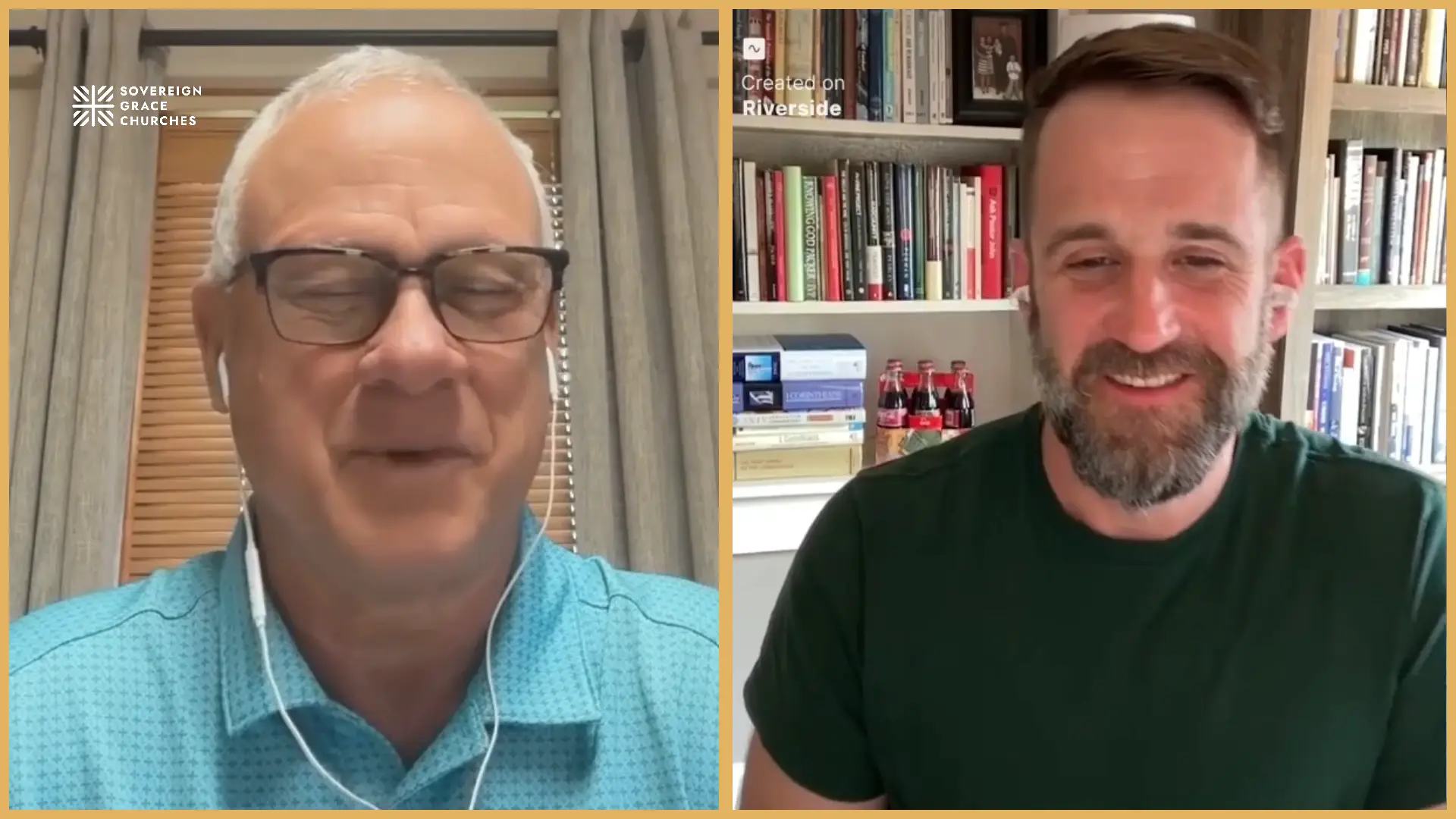
In this episode, seasoned pastor Steve Teter shares insights from his 37 years of pastoral ministry, emphasizing the importance of long-term care, suffering, and biblical faithfulness. Listeners will gain practical advice on pastoral care, sermon preparation, and maintaining joy in ministry.
The Ordinary Pastor Podcast is available on YouTube and wherever you get your podcasts.
Meet Steve Teter
Walt: Thank you for coming. I’m on today with my friend Steve Teter. Excited to have you. How are you doing, Steve?
Steve: Doing really well. Thanks.
Walt: We’re plugged in and excited to talk over the interwebs and interview Steve. I’ve titled the series “Older, Ordinary Pastors Getting It Done.” A lot of people in our day and age have a microphone, and a lot of people think they have a lot to say, but I tend to think we need fewer microphones and more people who have the experience, the wherewithal, the wisdom, and the growth, and we need to deploy them. Particularly in Sovereign Grace, I have a burden for us to hear from these ordinary pastors getting it done, these older pastors.
Walt: A little intro about Steve: Steve and his wife, Linda, have been married forty-six years this August. It’s like an eternity. They have five kids and eleven grandkids, and I know several of his kids are in the church with him. Steve has served as senior pastor of Living Faith Church in Franklin, West Virginia, for thirty-seven years. Hard to believe.
Steve: Hard to believe.
Growing Up in Franklin
Walt: Steve, I wanted to begin by hearing your background: where you grew up and how you came to saving faith in Christ.
Steve: I grew up here in Franklin. It’s a beautiful area, and I always wanted to move back. When I went to college, I started studying to be a veterinarian, but my older brother became a veterinarian, and I thought, there’s not room for two of us back in Franklin. We have a couple of other vets here as well. So I thought I’d go into dentistry, study it, and come back and practice with my dad. I’ve always loved this area. I never really wanted to live anywhere else.
Walt: Franklin is a town of how many?
Steve: About 750 people, and about seven thousand in our county. We have one stoplight in the whole county, a lot of mountains, a lot of woods, and a lot of wildlife.
Walt: That’s very different from how a lot of our listeners grew up. What was it like growing up in that area?
Steve: It was a wonderful time. My dad was a dentist, and we lived on a small farm, so I spent most of my life outdoors. I loved sports, and I knew a lot of people in the area. I had built-in accountability, because my parents knew a lot of people as well.
Walt: Yeah.
Steve: They were watching. That’s exactly right. It was wonderful growing up here. In some ways it was insulated, though as time goes on, with more and more media, less so. But it’s still a very rural area. Business-wise, it’s not a prosperous area, but it is beautiful, and it was a joy to grow up here. Then I went away to college at West Virginia University, for both undergraduate and graduate school.
Steve: We did travel some. My parents would go to Gideon conventions, so we traveled to cities for vacations. I remember Houston, San Francisco, and Montreal. They would go to their conventions, and as kids we got to do fun things while we were there. It was a good time.
Meeting Linda
Walt: Did you meet Linda in Franklin?
Steve: Yes. Linda’s father opened our first grocery store here in Franklin. She moved here in seventh grade, so that was quite a culture shock for her. I knew her in high school, we began to date in college, and we got married while we were both in graduate school.
Walt: So you got married in graduate school and moved back to Franklin. You never lived anywhere else besides those years away?
Steve: Never. My house is about two hundred yards from my parents’ house, where I was raised.
Walt: Wow. Unusual, but powerful.
Coming to Faith in Christ
Steve: I had a wonderful father, who has passed away now, and I grew up in a Christian home and came to know the Lord at a fairly young age, which I’m very grateful for. I’d heard the gospel from my parents. They were involved in the Gideon ministry, which has a high view of Scripture. We attended a Methodist church, and when I was younger, we had a Methodist revival there. They would do week-long revivals, and one evening, as the preacher shared the gospel, he gave an invitation at the end.
Steve: I was twelve years old, sitting between two friends. The Lord used that invitation to open my heart and regenerate it. I was convicted of sin, responded to the gospel, went forward, and prayed to receive Christ. The friends on either side of me did not. That has always stuck with me. They may have become Christians later on, but at that time they did not.
Steve: As I think back, it’s always amazed me. I remember the pressure I felt, wondering whether to respond or not, but then I did, and I thank the Lord for that. I think God protected me from many things, because of my own personality and the sins I struggle with. Becoming a Christian at a young age was God’s grace in my life.
Walt: Praise the Lord. Those stories never get old.
Called from Dentistry to Pastoral Ministry
Walt: You went away for dentistry, and you came back. I know a little bit about your story, but particularly with something like dentistry, where you’ve invested so much money and so much time, how did you discern the call to pastoral ministry?
Steve: That’s a good question. Through the charismatic renewal, young people had come to Christ, including my older brother, and at the same time the denomination was drifting away from a high view of Scripture. My brother began to encourage my parents: “You should have a Bible study in your home.” That was 1975. So they started a Bible study in their home on Wednesday nights. Mostly young people came, and a few others, anywhere from half a dozen to thirty-five people. They continued it for seven years. When we kids came home in the summers, we’d attend, though when we were in college there were fewer people.
Steve: When Linda and I came back from college, we decided, through my brother’s urging as well, that we couldn’t continue in the church we had been in. There were a lot of basic doctrines they no longer believed, regarding the atonement, the virgin birth, and other things. A lot of denominations were going through that. So we began meeting in our apartment, five of us, and then we invited others. After a few months, we had half a dozen people. We called a pastor to come lead our church, a man my brother was familiar with, and he led for a couple of years.
Steve: To make a very long story short, we learned about Sovereign Grace Ministries, which at that time I think was People of Destiny, or whatever they were called. They had a leaders’ conference. Our pastor went, connected with some of the leaders there, and we began a process of adoption over the next three or four years.
Steve: For me, the call to pastoral ministry really began when we joined Sovereign Grace. For the first time in my life, I saw a model of pastoral ministry that was compelling. I grew up in the Methodist church, and in those days (I don’t think it’s so much true now) pastors moved every few years. The way the structure was set up, they were hired and fired regularly, I’ll just say that. So there was no kind of family life, nothing compelling. When we joined Sovereign Grace, I saw a compelling model of pastoral ministry and care that I had never seen. I also saw a passion and a vision in the movement. At that point, I think God began stirring my heart.
Confirming the Call
Steve: I had been teaching and leading worship and Bible studies over the years. Others would say, “I really feel like God gives you insight into the Scriptures. I feel like you’re effective publicly.” The pastor who was leading our church at that time, who came from Sovereign Grace, said, “I think you’re called into pastoral ministry.” Others around me were saying it as well.
Steve: Something interesting happened during that time. I was wrestling with it, because I’d been practicing dentistry with my dad for six years, and I loved dentistry and loved the patients. Dad was wonderful to work with. But I began feeling a sense of call, and I remember thinking, this is such a massive decision. I prayed, “Lord, I pray that you’d confirm this call if it’s of you. I don’t want it to be of me.”
Steve: A man with a prophetic gifting came through and spoke at our church. Following the meeting, which seemed to be a genuine word of knowledge, he said, “Is there anyone who desires prayer? Come on up, and we’ll pray for you and see if God has a word.” I think four of us went up. I was third in line, if I remember. I knew what I was going to say: “Lord, we don’t make decisions because of a prophetic word,” but I was asking the Lord to confirm something I was sensing in my heart.
Steve: He went to a couple of other people first and then came to me. He stood there for a minute, said a couple of little things, and then pointed at me and said, and these are the words, verbatim, “You know you’re called, and God knows you’re called, and don’t say why. Just say why not.” I thought, Lord, that’s the confirmation I’ve been needing to make a massive decision that will change the course of my life, my family’s, and Linda’s.
Steve: I talked with Linda, and she was totally on board. Then I went and spoke to my parents. I said, “I have something to tell you,” on their back patio one evening, and my mom said, “You feel called into the ministry?” I said, “Yeah, I feel called into the ministry.”
Steve: Then I went and talked to my wife’s parents. Her dad at that time was not a Christian, and we didn’t know how he’d respond, but he said, “Well, Steve, dentistry is your occupation, but the church is your passion, and I’m all for it.” It was the Lord’s kindness. He later became a Christian, by the way, and was a wonderful man. All of our parents supported us. So I’d say I felt the internal call, there was external confirmation, there was even, I think, a supernatural confirmation, and those around us really supported the decision.
A Father’s Blessing
Walt: Your dad was encouraging you toward dentistry, you start working with him, and then you say you’re moving into pastoral ministry. What was his response?
Steve: He never recruited any of us to be a dentist. I was the youngest kid and the most rotten child. There are five of us in the family, three boys. My older brother became a physician and my second brother became a veterinarian, and I went into dentistry to come back and work with my dad and to live here. I did enjoy the work. When I told him, I asked, “What do you think?” because he’d built a facility for me to come back and practice with him.
Steve: He said, “Well, Steve, we’ve always taught you to follow the Lord, and I want you to do what the Lord has called you to do.” Throughout his life (he passed away a few years ago) he never did anything but encourage me in ministry. When I was discouraged, he’d say, “Steve, you’re called to do this. It’s God’s gift to you, so don’t do anything else.” It’s an amazing blessing.
Walt: It’s hard to quantify the effect of a father like that pouring into your life.
What Thirty-Seven Years Has Taught Him
Walt: I love hearing about this model of ministry. I remember encountering the first pastor I wanted to be like. I’d met a lot of pastors I didn’t want to be like. So you were drawn to this model of ministry. How has your understanding of pastoral ministry changed in the thirty-seven years since you began? What do you know now that you didn’t know then?
Steve: Two things stand out. First, building a church, caring for people, and seeing them grow happens through sowing and planting and God causing the growth. It happens over time, not quickly. It’s long-term investing, long-term walking alongside people. Change doesn’t come quickly. We should know that, because it doesn’t come quickly in our own lives either.
Steve: The second thing that has surprised me is the degree to which God’s people will experience suffering. Becoming a Christian might keep you from some suffering that comes from sin, but overall we’re in an Ecclesiastes world, a fallen world, and being a Christian doesn’t insulate us from the everyday struggles, trials, and sometimes tragedies that people face. One thing that surprised me over thirty-seven years is how much people really do suffer as Christians.
Walt: And that inexplicable suffering, too.
Steve: Inexplicable, yes. When I was younger, I thought you could draw a straight line between cause and effect. Over time you realize that’s just not the case in many situations.
Walt: I love the model of ministry over time, particularly you being in one place and giving your people the gift of permanence: the same pastor caring for them and helping them as they work things out over time.
A Typical Week
Walt: What does a typical workweek look like for you?
Steve: Monday is my day off, like most pastors. Tuesday morning is our staff meeting, and Tuesday afternoon is administrative work. I’m also a regional leader for our region, so that adds more administrative work and more emails. Usually Tuesday and Wednesday afternoons are for those things.
Steve: I’m a morning person, so mornings are for message prep. I preach every other week here (Josh and I go back and forth), and I also visit other churches throughout the year. I’d say sixty-five to seventy percent of Sundays I’m speaking somewhere. Message prep is usually Wednesday through Saturday mornings, since I’m more effective in the morning. Sometimes it extends into Saturday afternoon.
Walt: Do you have goals for each of those days? What’s the difference between Wednesday and Friday as the week develops?
Steve: Wednesday is getting familiar with the passage, reading it. I don’t know Greek, and I wish I’d learned it. I never went to Pastors College. I’d urge everyone watching this to go. The year I was supposed to go, many moons ago, they canceled it, so I was put right into the ministry. Any young man watching this, go to Pastors College if you can. I’d love to learn Greek.
Walt: That’s your advertisement.
Steve: And as you get older, it’s hard to remember. Early on, I learn the passage. Then I study commentaries on Wednesday and Thursday and start crafting. I read the passage and try to outline it: the main points and the redemptive point of the passage. Then I craft the message. I might have some of it done Thursday, and on Saturday I try to fill it in so I can preach it.
Steve: When I was younger, I preached from an outline. Now I fill it in a lot more, because as you get older there aren’t three or four thoughts coming through. Hopefully there’s one or two. So I have to follow my message more. It’s reading, becoming familiar, getting commentaries, perspective, and insights, and taking a lot of notes. Then I pare those down into an outline and bullet points, and then add examples and an introduction.
Keeping the People Before You
Walt: When you think about applying a message, I know you’re thinking that through during the week. What guides your application, and how do you keep your people before you as you prepare?
Steve: I’ve been here so long that I know people, but I’m not thinking of individuals. I’m thinking of groups: young people, married couples, older folks. I’m in a smaller church where I’m familiar with everyone, and I don’t want to use the pulpit as a bully pulpit. I never want to be preaching at an individual, consciously or unconsciously. If I need to discuss an issue with someone, I should go and do it face to face. Then if someone says, “You were preaching at me,” I can honestly say, “No, I wasn’t thinking of you when I made that point.” I never want to do that, if that makes sense.
Walt: That does make sense. Would there be moments when you’re sharing a burden for the church more broadly, where you say, “I really feel like this is something we need to work on”?
Steve: Absolutely. I’ll certainly be thinking of our church as a whole. My point was just that I’m not going to use the pulpit to speak to someone about something I need to take to them privately. But I do think of groups. We have college students, and we have young adults who come here.
Steve: Last week I preached on Hebrews 12:1-3, and I was thinking of those who are just beginning the race, “fixing our eyes on Jesus as we run the race set before us.” That week I thought more about the young people running this race in their early years. Having run for many decades, I remember people who started well and didn’t finish well. I wanted to give these young people thoughts that would help them look realistically at the race, the hindrances they’ll face, and the sin that so easily entangles, so they aren’t caught off guard. They’ll know these things are there, and that they have someone to look to: the author and perfecter of our faith, who for the joy set before him endured the cross. So this week I was thinking more about the young people than the older ones.
Standing Up on Sunday Morning
Walt: On Sunday morning, you get up and stand there, and you’ve done it for thirty-seven years. Was that hard to get used to early on?
Steve: I’d always done some public speaking, though I’d never been formally trained. You’re going to laugh at this: I did a lot of speaking for 4-H, and in college I was on teams where you had to stand before people and give reasons. It was livestock judging, isn’t that funny? You had to remember everything you saw and wrote down, then stand before them and, extemporaneously, give reasons for why you did what you did. I think all that helped me. So I’ve never dealt with fear in our setting. Going to other churches is a little harder when you don’t know the folks, but I know these folks here.
When a Sermon Bombs
Walt: Can you share a time when a sermon bombed? We need a Steve Teter epic bomb.
Steve: You should probably ask people in the church. They could give you a whole list.
Walt: That’s exactly right. They’ve got the one from last week.
Steve: Yes, that’s right. I can’t give you one in particular that went so badly I went home upset, partly because the Lord is kind to me, and I’m getting older and can’t remember. I can tell you why sermons have bombed, especially when I was younger.
Steve: Number one, I preached way too long. I preached an hour, sometimes a little over. One of our members told me, “You are very loquacious.” I had to look it up, but it meant I spoke too long. So I preach much shorter now, thirty to forty minutes.
Steve: And where I would get in trouble: Mike Bullmore said, “Stick close to the mains.” In other words, stick close to the main points of your message. I think that’s the gem of preaching. If you get far from the mains, or you feel you’re not getting through and need to reiterate and expound and help people get it, that’s when sermons have bombed for me. I just said too much. I should have said, “Amen, let’s sing the final song,” and instead I kept going and kept going. By God’s mercy, I can’t give you an epic bomb. It’s probably out of my memory.
Walt: That is true. Bill Kittrell would call that circling the landing. It’s a very common tendency to stack things in at the end and have trouble landing the plane.
Swing Thoughts for Preaching
Walt: You’re a golfer, so if you could give us three swing thoughts… We were watching the Masters the other week, and the commentators talk about swing thoughts like they really know what’s going on in the golfers’ heads. What would be swing thoughts for preaching? “Stick close to the mains” is a good one. Anything else?
Steve: As we prepare God’s Word for our people, I think it’s critical that we pray it will have its effect on our hearts before we ever preach it. If it’s just a bunch of information, that’s not what God is looking for. God wants it to affect our people, but first it has to affect the hearts of those of us speaking it. I think God wants it that way. As we study and see that we have the author and perfecter of our faith, who for the joy set before him endured the cross, despising the shame, that should affect our hearts. So one swing thought is: stay in the study. We’re not just preparing a message. We’re preparing God’s Word, and we’re one of God’s people. It’s not a job. It’s not a talk. It’s unlike anything else public speakers do. We are the vessel through whom God’s Word comes, and the vessel should be affected the same way our people are.
Steve: What has built my confidence to preach on Sunday mornings is the confidence that God loves his people and wants them to hear his Word. Even when I was younger and thought I wasn’t very effective (and I’m still not sure I am), what stirred my heart was knowing that God loves his people. Even when I feel I’m not adequately prepared, or that there’s so much more I wanted to say, I remind myself: God will use me because he loves his people. That’s been a big one.
Steve: The last one is that we as Christian ministers have the most wonderful message in the world to give. I’m so glad I’m not an imam or a minister of another religion, because we really do have the good news, the most wonderful news of all. Even though it’s a fragrance of life to some and a fragrance of death to others, it’s still the most wonderful news to give. Even when we talk about conviction of sin and areas where we need to grow, in the end it’s good news. We have a living Savior who loves his people, who died on the cross for our sins, and who has given us new life. So remember that the message we have to give is great and wonderful news.
Walt: I love all of that, because it gives a biblical perspective on what you’re doing: on the gospel and on preaching. It’s not a talk. It’s unlike any other form of public communication. It’s God working in and through a human vessel to build up his church and sanctify it in all the ways it needs. That’s huge, and it’s encouraging.
Steve: And we need God’s help. I’m sure we can all pray more, but we do need the Lord. It is unlike anything else.
The Hardest Pastoral Situations
Walt: I want to dive a little into pastoral care. The Holy Spirit makes us overseers of certain people. We don’t care for everybody, but we care for some. Can you describe the most difficult pastoral situation you’ve faced, one that challenged you and was a learning experience?
Steve: The most difficult have been tragedies. I can think of three situations where someone lost a loved one or a child, unexpected deaths. Those are the three major ones in my ministry, including one involving a nephew and a sister, whom I love deeply. They have been by far the hardest pastoral situations I’ve experienced, and all three were inexplicable.
Walt: What did you learn pastorally in caring for those people over time?
Steve: There are no trite, simple answers. That’s number one. No cliches. “God loves you,” “God’s got to work good out of this”: those things can be cruel and harmful to say. “Well, God’s going to bring about good” is not helpful at all.
Steve: What I learned was to walk alongside people. David Powlison says something like, even a three-watt bulb brightens total darkness. We don’t have a hundred watts to give, but even coming into their lives and saying, “I’m thinking about you, I’m praying for you, I care for you,” over a long period of time matters. We had a tragedy just this past fall, when a young person was killed in a car wreck. It won’t be months. It’ll be years. It’ll be a lifetime. But in the early months, just coming to say, “I’m thinking about you, I’m praying for you,” doesn’t seem like much, yet people deeply appreciate knowing that the pastor cares and loves them.
Steve: So I learned to be there as a Christian pastor and a friend. It’s not a job. It’s being a brother. It’s very meaningful, but it isn’t going to heal the hurt. There’s nothing I can say that will. We just pray that God will meet them over time with his presence and his care.
Before You Open Your Mouth
Walt: Let me ask you to apply that. I can’t recall the exact details, but I remember the first hospital room I walked into where I knew I was in over my head. You’re intimidated. For the guys listening who are in pastoral ministry, or aspire to it: before they walk into a room like that, what would you want them to know before they open their mouth?
Steve: The first thing I’d say is: go in and don’t open your mouth. Go in and listen. Really. Just say you’re sorry. Don’t go in thinking you have to have answers, because for a lot of these things there are no answers. Come in, listen, tell them how sorry you are, and pray with them. It’s weeping with those who weep. Job’s friends did well for a while, when they came and sat beside him, but they blew it later on. It really is walking alongside and saying, “We don’t understand these things, but we love you, and I know God loves you.”
Steve: Eventually, over time, but not early on, it’s pointing them to the one place where God’s love is clearly displayed. With one friend I said, “I don’t understand why this happened. Based on what we see, we don’t know. But we do know God loves us, because two thousand years ago God’s Son died on the cross for our sins. That’s how we know God has loved us, not because of this. This is a fallen, broken world, but we do know that’s true.” I can’t explain this, but I can point you there. That helps people who are Christians. Over time, even those who are hurting the worst will say, “I know that’s true.”
Steve: The deeper they’re able to look at that objective expression of God’s love, the more confidence they’ll have, and the more ground. I liken it to being in a raging river with the water up to your nose, but there’s ground under there. You can stand on that rock, even if the waters are pouring past you.
Walt: Amen. What a vivid picture, and so true. It dispels so many notions about what pastoral ministry is. It’s not being the answer guy, or an apologist defending God in these moments. It’s the faithful work of holding out the hope of the gospel.
Steve: What I’ve learned over time is that you can weep and trust Christ at the same time. You can weep deep tears of sorrow and still trust Christ while you’re weeping. That’s where we want to help people get: “I don’t understand this. This is horrible. I don’t understand why God even allowed this, but I know this is true.”
Walt: Weep and trust Christ at the same time. It captures the desire to empathize with what’s going on, and also, biblically, the desire not to miss the opportunity to root and ground people, to keep interpreting what’s happening in light of the gospel, in light of Christ and our Savior.
The Most Challenging Season
Walt: Those are big situations. Pivoting a little, what’s been the most challenging season for you?
Steve: Early on. I felt expectations, and I felt overwhelmed. There seemed to be more to do than I could do. We had a young family when I became a pastor: three children, a fourth a few months later, and a fifth two years after that. I was the only pastor until we brought on another man, Brad Mitchell. It was overwhelming. There were critics (there were always critics), and that was a discouraging season. It’s always discouraging when you have departures, and that can happen throughout ministry.
Steve: But early on, being overwhelmed and feeling the pressure, I think I felt too much pressure. There were times I should have trusted the Lord more and said, “This is a process of building a church. It’s going to take a while.”
Walt: So some of that pressure you put on yourself.
Steve: Absolutely. I should have said, “We can cancel this care group this week. It’s okay. We can skip worship practice. It’s all right.”
Walt: The show will go on.
Steve: In spite of me, and sometimes because of me, but in spite of me many times. It’s okay. I think our church realizes that, and the way we walk either way affects our church. So for young guys just beginning to pastor, recognize that we’re building a church over time. It’s a marathon, not a racetrack. You know that. You planted a church. You know what it’s like.
Walt: We certainly do.
Critics, Departures, and Nicknames
Walt: You’re in a small town, and you mentioned departures and criticism. You’re not exactly having an influx of new people. No transients there. I’ve heard some of the stories, but you got a few good nicknames for the church.
Steve: When I became pastor, they had two names for us: “Teter Tabernacle” and “the Dentistry Ministry.” I thought that was really good.
Walt: I like that one. Everything was a tabernacle back then, so Teter Tabernacle works too. Was it a particular challenge to trust God with departures and with criticism from outside the church?
Steve: There was criticism and misunderstanding from the outside, because a number of folks who came early on came from other churches. In a small town, there’s a feeling of, “Our church is good enough for you. Why are you doing this?” Over time that has dissipated. I don’t think we have that anymore at all. But early on, yes.
Steve: And you deal with critics in the church as well. I was a young man with no ministerial experience. You certainly want to learn from criticism, because there can be truth in the midst of it. Sometimes it’s just criticism, like when my friend said I was quite loquacious. That was criticism, but it was right. But there is also criticism from people who are just critics. It’s freeing at some point to realize, I’m not going to please them, and I don’t need to.
Steve: So it’s about discerning who is just being critical, a fault-finder, and who maybe doesn’t understand and needs someone to sit down and talk with them. I’ve experienced both. Sometimes people are just bitter or angry, and you have to learn that you’re not obligated to modify your behavior or what you’re doing in order to please them. That’s very freeing.
Walt: It is freeing. Take what’s helpful: eat the fish, spit out the bones, so to speak. The New Testament talks about criticism, departures, and disagreement, so it’s not foreign territory. It’s part of the ministry of the gospel.
The Greatest Joy
Walt: What’s been your greatest joy in pastoral ministry?
Steve: The greatest joy has been having a church full of people, many of whom have been part of the church for decades and are still building together. We started in 1982, so we have people who have been here forty-four years. When I look back and see people who’ve been there for decades, we’ve grown together. There are people in our church I’ve grown up with. I’ve told the church, “You’ve been here a long time. You’re going to have great rewards in heaven because you put up with me and you stayed.”
Steve: It’s a great joy to have people I’ve known my whole life who came to church, stayed, and grew with us. There’s still more sanctification needed. We know each other. We could read each other’s mail. But we’ve chosen to stay together and build this church to the glory of God. That’s the most rewarding part of pastoral ministry for me.
Staying Put: Wanting to Quit
Walt: Isn’t it great seeing those faces on a Sunday morning? Was there ever a time you thought about leaving?
Steve: There were several Monday mornings I wanted to quit.
Steve: There are always times you get discouraged. I really do believe we battle not only against flesh and blood but against principalities and rulers of wickedness in high places. Early on, it seemed that difficult or bad things would come in threes. I even said once, “These things don’t come one at a time. They come in threes.” There were times of discouragement in my heart, going through hard times for various reasons, and I’d feel like I wanted to quit. That’s when my dad would say, “This is what you’re called to do.”
Steve: The other question is what helped me stay in it. One thing was my wife. She’d say, “If you don’t have grace for this, then just quit.” That pretty well put the decision before me. She knew I wasn’t going to quit. Through her exhortations to buck up, that I was called to this, not to give up, not to be discouraged, to quit feeling sorry for myself (and we can be tempted to that), and through the encouragement of others, I stayed. And I’d burned the bridges behind me.
Walt: You get far enough along and no one else is going to take you anymore.
Steve: Everything behind you. And friends. I do want to add this, no joke: as a Christian pastor, I have some wonderful friends, both men in the church and other pastors. During difficult seasons of my life, God would bring friends. I can think of three: Mickey Connolly, Bill Kittrell, and C.J. Mahaney. There are others, but particularly Bill and Mickey, whom I saw more than C.J., were regularly an encouragement to me through the years. Many times I’d be down. Mickey was our regional leader, and he’d come visit the church when I might just be discouraged, and his presence and encouragement, and Bill’s as well, stirred me on.
Steve: So if you’re going to be a pastor, have some friends. And this is my second plug for Pastors College: go, and build some friendships. Have friendships for decades. It’s made all the difference in my life.
The Value of Partnership
Walt: I’d love to zoom out a little. You’re talking about friends beyond your location who have been significant, which leads me to the role of partnership. Living Faith is in a small town and yet has enjoyed this partnership for decades. What difference has that partnership made for Living Faith Church?
Steve: I can say with all integrity that had we not become part of Sovereign Grace, we wouldn’t be a church. We wouldn’t have lasted. The oversight, the care, the training (for me, the training), the encouragement, the resources, and the relationships: besides the Lord’s grace, those are the means of grace he used to build our church. No question.
Steve: Our church knows a number of men who come in and preach. Mickey has been here to preach for thirty years. Maybe he missed one year, but in thirty years he’s come and spoken here. And these men, and the doctrine we’ve learned… I don’t think I’m overly discerning doctrinally, and there are major things I would have missed along the way. I need those men around me. I need more gifted men. We need the Jeff Purswells and the Josh Blunts and all the others who are guarding us doctrinally. We need men who are leading us. We need leaders’ conferences to go to that spur us on and strengthen us. All of that has made all the difference, and we would not have survived here without it. To be honest, I wouldn’t pastor without it. That was part of the model I saw that was different from what I’d seen. I saw pastors who were alone my whole life growing up.
Walt: What’s the value been for the church? They’ve seen Mickey for thirty years. How is it different for them, partnering?
Steve: We realize we’re part of something beyond ourselves. We just had a Pastors College student in to preach three weeks ago, and they loved that. They love Pastors College, and they love the missions we’re involved with. I brag on our church, not because I’m the pastor, but because it’s a generous church. They love supporting the guys who come in, and other ministries around the world, financially.
Steve: We just feel like we’re part of something beyond ourselves. It can become tunnel vision in a small town, and probably in any church, but we don’t feel that way at all. Every month we have a Mission Sunday. We don’t do a message, but we take up an offering for missions and give updates. So we know we’re part of what’s going on in the Philippines, Pakistan, Thailand, other countries around the world, and also in our region. It’s huge for us.
Books That Shaped Him
Walt: A few more questions, a little random. What books have shaped you, or shaped your ministry, the most? Do any immediately come to mind?
Steve: You gave me this question earlier so I could look it over. For me it would be authors more than books. Jerry Bridges on the Christian life would have been big for me. Knowing God was a big book for me, and J.I. Packer’s material in general. R.C. Sproul was massive early on, especially The Holiness of God. We used to listen to cassette tapes, and I had lots of those. That’s how I came to Reformed theology. Anthony Hoekema’s Saved by Grace was a paradigm-shifting book for me. John Stott’s The Cross of Christ was big. And Wayne Grudem’s Systematic Theology, the big one, not the small one. I read through that one.
Walt: Yes, me too.
Steve: I’ll also mention an article. “The Weight of Glory” by C.S. Lewis was paradigm-shifting for me in my Christian walk. Basically, God wants us to love him and to serve him out of love, not duty. There are a number of quotes in there that really affected me, like the idea that there are no ordinary people.
Steve: I think Piper helped with this too, in some of his messages and maybe in The Pleasures of God or Desiring God. If you go to your wife and give her a kiss and she says, “Why did you kiss me?” and you say, “Well, I’m supposed to. I’m your husband,” that’s not a blessing. God doesn’t want us to serve him because of duty, because we’re supposed to.
Walt: He pushes back on that, doesn’t he? That’s a staggering thing.
Leisure and the Second Book
Walt: Unlike most of our listeners, probably, you’re a good golfer, a good fly fisherman, and a good hunter. What role does leisure play? This generation seems to just play on their phones. That’s what they do for leisure. What role has leisure played in your personal life and in your pastoral ministry?
Steve: First of all, the guys in our church would laugh if you called me good at any of those things. I’m moderately okay.
Walt: There are some giants out there.
Steve: It’s been said that creation is the second book. For me, getting out in creation is experiencing the Lord. I think it was Charles Spurgeon who said that what a lot of young men need is just to get up from their desk and walk in a stiff breeze, something like that. We need the breaks. We need the refreshment. We need to recharge. We need those times so we can come back fresh, thanking God for life and for what he’s given us.
Steve: We need to be refreshed away from the ministry, with friends who don’t need us. One of the dangers as pastors is that people need us. We need local friends who don’t, quote-unquote, need us. They aren’t looking for our counseling or anything else from us. They just like to laugh with us. Look for friends who aren’t afraid to make you the butt of a joke and laugh with you. Getting out with those guys and playing helps center us again on the truth that God is good, and that life is much broader than sitting at a desk. God has given us all things to enjoy.
Walt: That second book. That’s huge. That’s wonderful.
Advice for Young Men
Walt: One last question. For the guys listening, whether they’re in high school, in college, or working another job right now, and whether they’ll be in pastoral ministry in a couple of years, in ten years, or never, what would you encourage them to do right now?
Steve: Number one, be a man of the Word. If you’re going to be in pastoral ministry, it’s about the Word, the revelation of God given to us in his Word. Have a strong conviction about that and be a young man of the Word. Read Scripture, study Scripture, memorize Scripture, and meditate on Scripture. That’s the first thing.
Steve: The second thing I’d say is be faithful in little. Don’t be looking to the future, wondering what you’ll be doing ten years from now. Be faithful where you are. Ask your pastor how you can serve, what Sunday school class you could assist in or teach, and what you can do to build the church. Be faithful there.
Steve: And then find someone who’s further along in the faith than you, whom you respect, who loves God and is humble, and ask them to mentor you, speak into your life, and give them free rein. Those are the three things I would say.
Closing
Walt: That is so wise. Be a man of the Word. Be faithful in little. Find someone further along who can speak into your life, and give them free rein. That’s so helpful.