
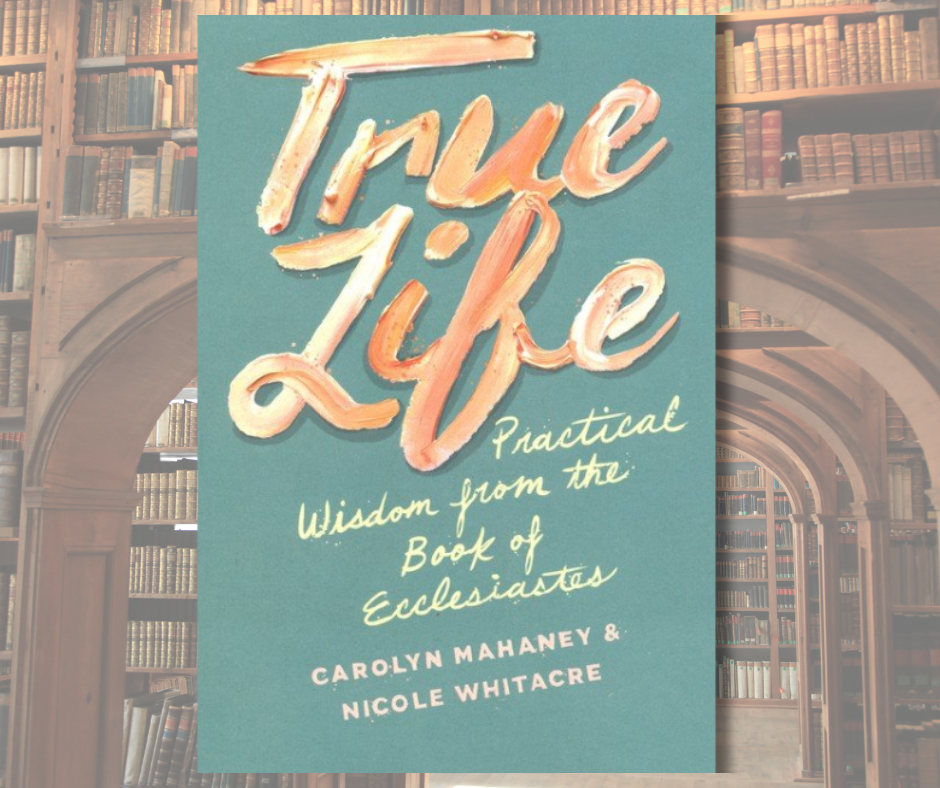
This month we’re highlighting the value of biblical womanhood and talked to Nicole Whitacre, one of the authors of True Life: Practical Wisdom From the book of Ecclesiastes. Nicole is a pastor’s wife, founder and head teacher at Trinitas Classical Academy, and author of several books. We thought her encouragement to moms (and other women) to find life in the often neglected book of Ecclesiastes would be encouraging.
Question: You write that Ecclesiastes helped make you “happy, hopeful realists.” What does that phrase mean, and how is it different from just being pessimistic about life? Or perhaps just naive?
Nicole: If we want to be happy and hopeful women, we must learn to be realistic about life in a fallen world. Many of us have a hard time believing (maybe because we don’t want to?) that what the Bible says about the hardships of life will be true for us. But Ecclesiastes sets us straight. The opening cry translated “vanity” (1:2) is the Hebrew word “hevel” which literally means “breath” and conveys the idea that everything about our lives is “uncontrollable and incomprehensible.” It tells us in verse 8 that “all things are full of weariness” (not just final exams and fussy babies, but all things). It tells us that everything we accomplish will be unsatisfying and unremembered, and that life itself is an “unhappy business” (1:13). We get all this from Chapter One. Moving on, Solomon tells us that life is painful, risky, unfair, and wherever you are in the journey—it only gets harder from here. As Derek Kidner puts it, Solomon “disillusions us to show us reality.” So, when we say “My life feels out of my control!” or “I just don’t understand what is happening to me!” we are more realistic than when we think we’ve got it all planned and figured out. We cannot control our lives, and we cannot understand the past or predict the future from here.
So how does being realistic (Ecclesiastes style) make us happy and hopeful? That’s the money question, isn’t it? As one woman told me recently: “I’m so tempted to fear already that I’m afraid if I meditate on Ecclesiastes, I may not be able to get out of bed in the morning!” The opposite is true, in fact. Becoming an Ecclesiastes realist protects us from pessimism and despair on the one hand (think Eeyore from Winnie-the-Pooh) or naive optimism on the other (think Jane from Pride & Prejudice).
Yes, life is full of hardship and weariness, that is true enough. But that is not all that is true. Ecclesiastes tells us that we cannot control our lives, but it also tells us that God is in control of our times and seasons, and that he is making “everything beautiful in its time” (3:11). Solomon tells us that life is full of unhappy business, but he also tells us that God will keep us occupied with joy in our hearts (5:20). Ecclesiastes helps us to be happy in the present—because God is the one who occupies us with joy—and to be hopeful for the future—because God is making absolutely everything beautiful in his time. That is how Ecclesiastes makes us happy, hopeful realists.
Question: You share honestly about a season of trial that was hard and wearying. But you share that reframing your expectations was one of the things that helped most. How did Ecclesiastes help reframe your expectations?
Nicole: As the poet Longfellow once wrote, “Into each life some rain must fall,” and for many years, that was my unbiblical expectation about life. But when one monsoon after another roared through the lives of my parents and our whole family, I was surprised every time, and not in a good way.
Martin Luther, commenting on Ecclesiastes, says that’s the problem: we are always so unpleasantly surprised by all of this unhappy business. Instead we should “expect evil things daily” because “that is how it is in this life.” On the other hand, says Luther, “good things are beyond expectation, and that is how they come. But when they do come, we should give thanks to God for a special act of kindness.”
So often, we are disappointed when our plans go wrong, angry when someone is unkind, fearful when we get a bad diagnosis, and generally hopeless when our life doesn’t turn out like we dreamed. Even though Ecclesiastes tells us ahead of time that life is full of this kind of thing, we’re still so surprised, and not in a good way. This always being so surprised by trouble is no way to live, Luther says.
In short, Ecclesiastes teaches us to expect bad things and not to expect good things. If we expect pain and trouble it isn’t quite so bad, and if we don’t expect good things, they come as a pleasant surprise. So prepare to trust God for (expected) bad things and give thanks to God for all the (unexpected) good things. “Ecclesiastes expectations” help us to face life challenges and receive God’s blessings, minimizing our unhappiness and maximizing our joy.
Reframing expectations is an Ecclesiastes specialty. It reframes our expectations about life—what we can get out of it (toil), what we can hold onto (nothing), and what we can receive from God (joy)—but it also reframes our expectations about people. Again and again, Ecclesiastes reminds us that we cannot put our hope in other people. We tend to expect other people, especially family and close friends, to meet our needs, always be there for us, and generally provide all the good feelings and experiences we want out of life. Then when a close friend or family member disappoints or betrays us, or simply fails to express the gratitude we think we are due, we are shocked and dismayed.
To protect us from misplaced trust, Ecclesiastes teaches us that life is not fair and that relationships will disappoint. It points out that the poor man may save the city, but everyone will forget about him (9:15). It exposes envy as a prime (albeit destructive) motivation for all the work that is done “under the sun” (4:4). Ecclesiastes not only cautions us about trusting in people rather than God, but it reveals the envy that may be present in our own hearts, leading us to repent. Wisely considered, Ecclesiastes reframes our expectations about life, about others, and most importantly, about ourselves, teaching us to walk humbly in the fear of the Lord (12:13-14).
Question: A common refrain we hear from women is that they feel “exhausted.” You share that some of this may come from trying to control outcomes in relationships, children’s lives, work. What does Ecclesiastes say to that “exhausted” woman?
Nicole: First, Ecclesiastes tells us that it’s normal to be tired and weary. “All things are full of weariness, man cannot utter it” (1:8). It is comforting to realize that Scripture has already told us life would feel like this. I remember when my husband Steve and I had two children and then adopted two more at the same time—we didn’t know it was possible to feel so tired! It was also the happiest tired we had ever felt, before or since.
But as you note, there is another kind of exhaustion and weariness that is not merely physical, but sinful: an exhaustion brought on by our own futile efforts to control our lives. We wear ourselves out grasping for things just out of our reach (security, success, satisfaction), and we are exhausted by trying to hold onto and control what we already have (relationships and possessions). We fight against the way things are: trying to earn, achieve, control, and keep every good thing. Even though we cannot “level up” in life, we exhaust ourselves with the trying.
Ecclesiastes tells us the cure for this ungodly exhaustion. Stop being exhausted! In other words, stop your fretful and fruitless attempts to control, manage, and achieve the good things in life. Instead, repent to God, receive from God, and rest in God. Work hard and enjoy your work as a gift from the Lord. In a word, obey instead of strive. Obedience is never exhausting, because it is, as Elisabeth Elliot put it, “the gateway to joy.” Tired as we may be after a long day of obedient work, we will not be exhausted. Instead, we will be the best kind of happy tired.
Question: I love that midway through the book there’s a sudden, happy pivot with the chapter “Life Is Enjoyable.” How can life be enjoyable despite all the “vanity” Solomon describes?
Nicole: The sudden happy pivot in our book mirrors Solomon’s happy turn. In Ecclesiastes 2:20 he (rightly) despairs over life in a fallen world: “So I turned about and gave my heart up to despair over all the toil of my labors under the sun.” Then in verse 24 he turns to joy in God: “There is nothing better for a person that he should eat and drink and find enjoyment in all his toil. This also, I saw, is from the hand of God, for apart from him who can eat and drink and find enjoyment? For to the one who pleases him, God has given wisdom and knowledge and joy” (2:24-26).
This is the turn of repentance we all must make: from despair over the world to joy in God. Only those who are in Christ can please God and only those who please God receive joy. And oh what joy they receive! Even in the midst of this difficult and sin-riddled world, God promises that we will not so much remember the days of our life because God will keep us occupied with joy in our hearts (5:20). As J.I. Packer says, even though life may not be a “joy ride,” it will most certainly become “a joy road” for the one who pleases God.
Question: You mention that the book is written specifically for women in every season of life. How does Ecclesiastes speak differently to a 22-year-old just starting out versus a woman in her 50s who has lived through a lot of disappointment?
Nicole: I’m always telling my grown children or the Trinity College students I teach to “read Ecclesiastes.” Solomon wrote the book for young people, to help them avoid making the same mistakes he did, and to teach them how to enjoy life in this vain world “under the sun” (1:3). Solomon’s advice for young people? “Remember also your Creator in the days of your youth, before the evil days come” (12:1). When young people recognize that evil days are coming, they learn to look to God for purpose, joy, and satisfaction. Ecclesiastes is also full of life-hacks for dealing with work, relationships, goals, decision making, and more, which also makes it a fun study for the young.
I turn fifty this month, and Ecclesiastes helps me more than ever. First, it makes sense of the past, specifically ways in which my life did not go the way I expected or hoped it would. God was in control, ordering the times and seasons of my life, making “everything beautiful in its time” (3:11). Second, it prepares me for the future. As I get older, life gets harder, and Ecclesiastes tells me that it’s going to get harder still. It protects me from putting my hope in a failing world and reminds me to look to God, the giver of all good gifts. Armed with biblical wisdom, I can meet the challenges of old age with courage and joy.
No matter our age, Ecclesiastes tells us the only way to live: “The end of the matter; all has been heard. Fear God and keep his commandments, for this is the whole duty of man. For God will bring every deed into judgment, with every secret thing, whether good or evil” (12:13-14).
Question: You describe this book as “not a commentary but a testimony.” What do you mean by that, and why does that distinction matter to readers?
Nicole: It was important to us to explain how we approach writing, and how we hope women will approach reading our books. We write all of our books in submission to our pastors (two of whom happen to be our husbands and who guide us theologically) and not aspiring to be thought of as “women teachers.” Our hope is that women in the church today will look to faithful pastors and husbands for theological guidance (and book recommendations!) so they might grow in grace, knowledge, and joy in Christ.
As the authors of True Life, we are just two ordinary women, a mother and a daughter, recounting how God used Ecclesiastes to teach us to enjoy Christ and his good gifts as we walk through this weary world. It’s also interesting to note, that for all of Solomon’s wisdom—after Jesus, he was the second wisest man in all of history—he presents Ecclesiastes as a personal testimony of repentance leading to joy. In some small way, we tried to imitate his example for the encouragement of other women.
Nicole Whitacre is a wife, mother, homemaker, teacher, and author. She and her husband Steve and their four grown children make their happy home in Pewee Valley, Kentucky, where her husband is a pastor at Sovereign Grace Church of Louisville and the president of Trinity College of Louisville. Nicole is the founder and head teacher of Trinitas Classical Academy Online and a guest lecturer at Trinity College. She co-hosts the Vocatio podcast and is the co-author of several books, including Girl Talk, True Beauty, True Feelings, and True Life, and the author of True Happiness, forthcoming from Crossway Books.